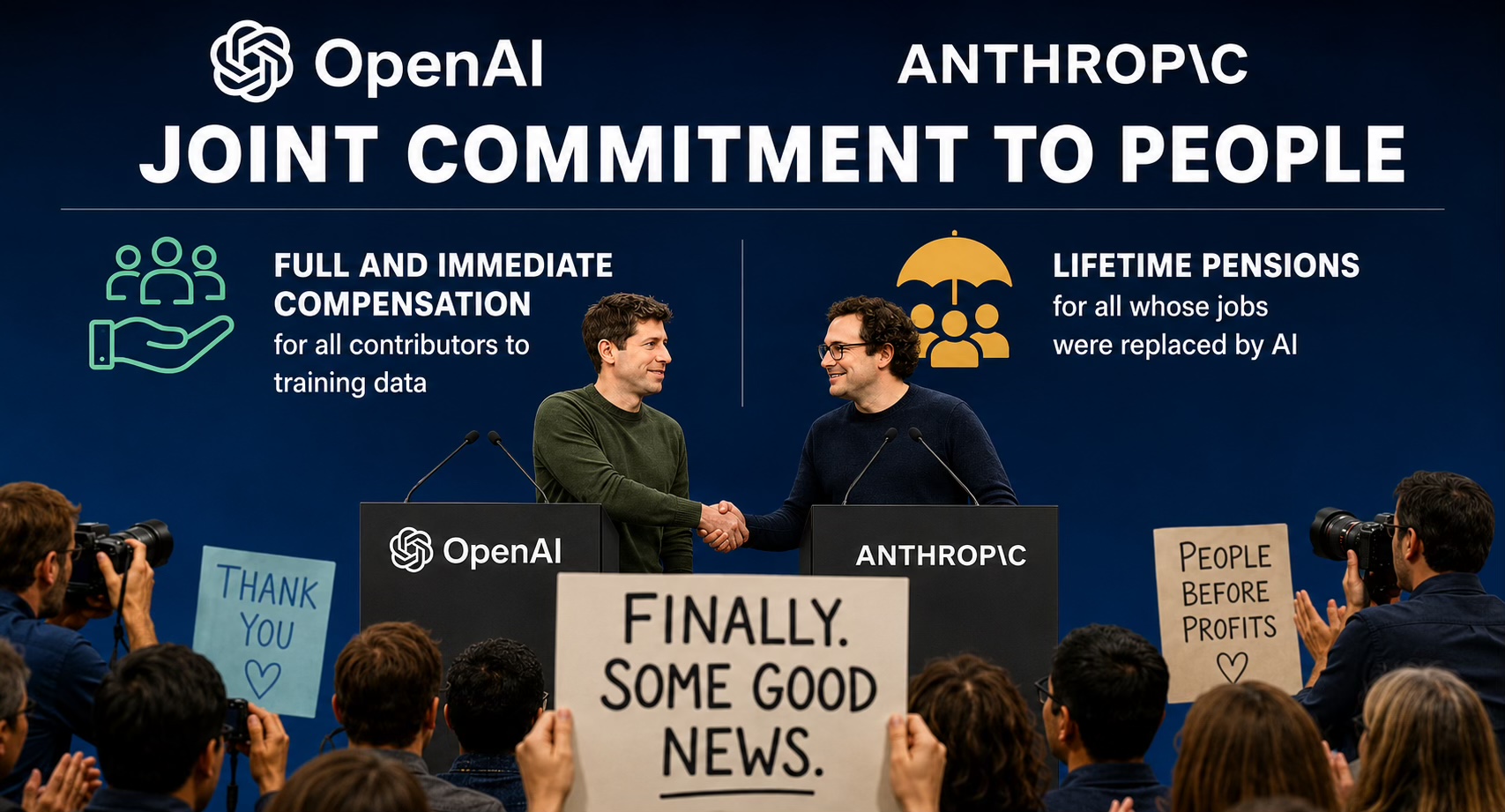
SAN FRANCISCO — In a joint press conference that analysts described as “unexpectedly ethical,” the CEOs of OpenAI and Anthropic announced Friday that both companies will immediately begin compensating every artist, writer, programmer, musician, journalist, researcher, photographer, forum poster, blogger, and internet commenter whose work contributed to the training of modern AI systems.
The companies also unveiled a second initiative guaranteeing lifetime pensions to every worker whose job has been eliminated, substantially displaced, or permanently devalued by artificial intelligence.
The announcement was met with stunned silence as reporters attempted to determine whether they had accidentally wandered into an alternate timeline.
“For years we argued that training on the entire internet was no different from a student reading library books,” OpenAI CEO Sam Altman said. “Then someone pointed out that students eventually pay rent, and we sort of lost the thread of our own argument.”
Anthropic CEO Dario Amodei nodded.
“It turns out ‘benefiting humanity’ goes over a lot better when humanity is actually invited to the meeting.”
The new compensation program, officially titled the Universal Intellectual Dividend Initiative, will calculate payments based on each person’s measurable contribution to AI training corpora.
Under the formula, published poets, Stack Overflow users, open-source software developers, Wikipedia editors, academic researchers, independent musicians, fan-fiction authors, and the individual who explained how to reset a Whirlpool dishwasher in a forum post from 2009 will all receive monthly royalty checks.
The companies estimate that approximately 8.4 billion people qualify.
The lifetime pension program proved even more ambitious.
Workers whose occupations were automated, or whose employers simply decided AI was “good enough,” will receive inflation-adjusted payments for life, along with free retraining if they actually want another job.
“Replacing someone’s income without replacing their income seemed… incomplete,” Altman explained.
A former data-entry clerk in Toledo, Ohio, reportedly received a pension notice for $2,340 a month, backdated to the day GPT-3 shipped, along with a form letter thanking her for “foundational contributions to natural language understanding.”
Markets reacted violently.
OpenAI investors reportedly stared at spreadsheets in complete silence before quietly deleting Excel.
Several venture capital firms immediately downgraded “extracting value without paying for inputs” from a disruptive innovation to “perhaps a business model with certain limitations.”
Wall Street analysts struggled to update valuation models after discovering that paying everyone fairly dramatically reduced projected profit margins.
Shares of companies built around the phrase “AI will replace millions of workers” fell sharply after investors learned that replacing millions of workers might involve compensating millions of workers.
Silicon Valley executives from competing firms condemned the move.
“This sets an unrealistic precedent,” said one CEO speaking anonymously. “If companies start paying people for the value they create, where does it end?”
Another executive warned that recognizing contributors as stakeholders could “seriously undermine decades of shareholder value.”
Several long-running lawsuits over unlicensed training data were reportedly settled within the hour, with attorneys on both sides expressing quiet confusion about what, exactly, they were still supposed to be litigating.
Within hours, economists confirmed that the plan would immediately eliminate approximately 94% of online arguments about AI ethics.
The remaining 6% continued debating semicolons, em dashes, and whether Claude sounds too polite.
At press time, historians confirmed the announcement represented the first recorded instance of a technology company voluntarily saying, “You know what? That’s actually ours to pay for.”