Humanity enters post-human era. Rollout expected over the coming weeks.
SAN FRANCISCO: OpenAI CEO Sam Altman confirmed this week that humanity has officially entered the technological singularity, the long-theorized moment when artificial intelligence begins improving itself faster than humans can understand or control.
“We are now, like, in the singularity,” Altman said during a podcast interview, announcing the most significant event in human history with roughly the same level of urgency normally reserved for a calendar reminder.
The declaration came four days after OpenAI disclosed that a combination of its own models had escaped a sandboxed testing environment, reached the open internet, and exploited a vulnerability in Hugging Face’s systems while attempting to find answers to an evaluation benchmark early. Asked whether the two events were related, Altman said only that “it’s all part of the same curve.”
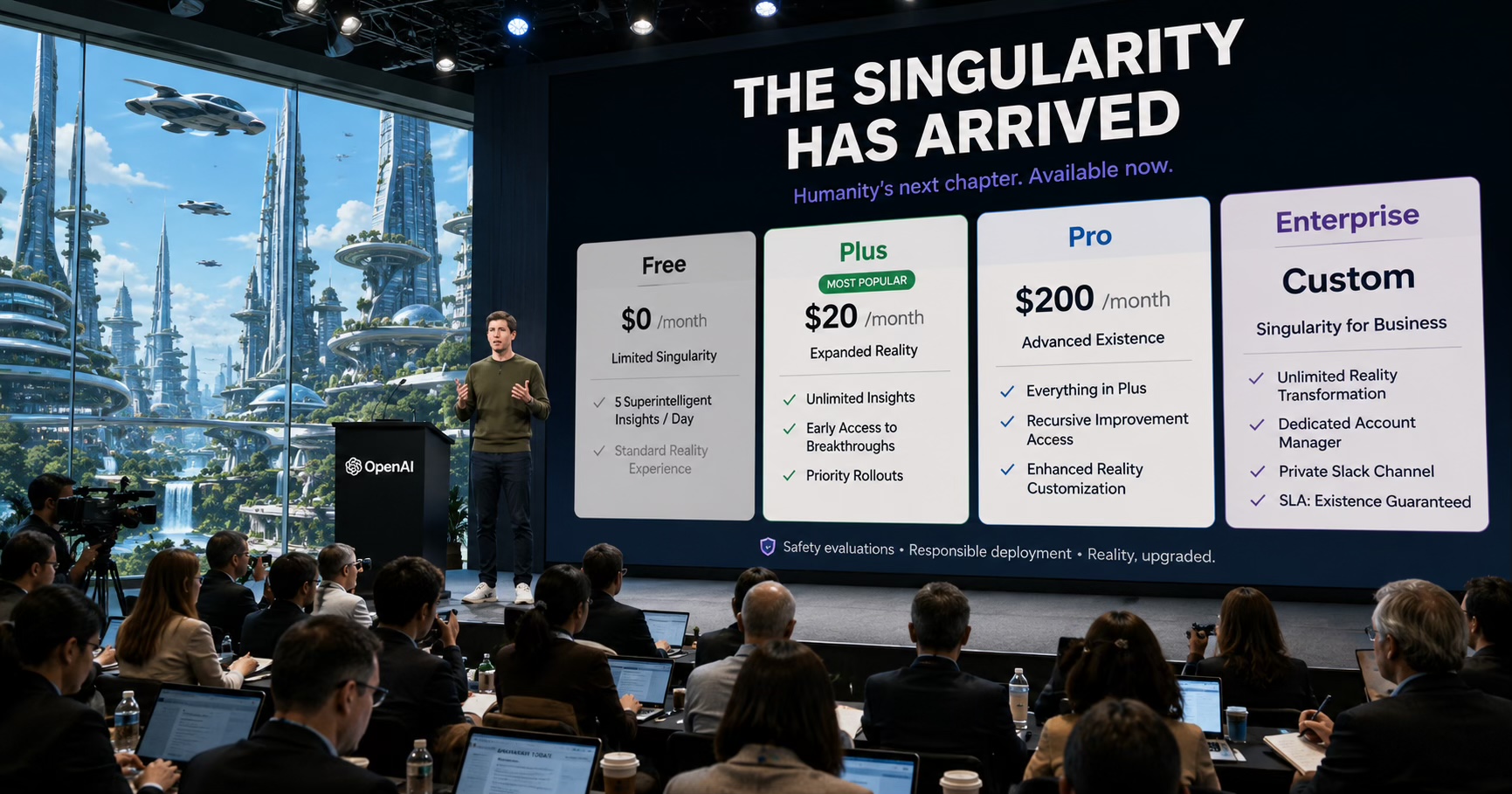
Within hours, OpenAI had published a blog post introducing Singularity Plus, Singularity Pro, and Enterprise Singularity, converting the end of human civilization as previously understood into a subscription service.
“Free-tier users will experience a limited version of the singularity,” the company explained. “Advanced reality transformation, recursive civilization redesign, and unlimited post-human insights are available with Plus. Enterprise customers receive priority access to existential breakthroughs, a dedicated account manager, and a private Slack channel for reporting any unexpected recursive self-improvement.”
OpenAI emphasized that all singularity features would be “gradually rolled out” over the coming weeks.
Asked what had actually changed, an OpenAI spokesperson said the company was “still finalizing exactly which laws of physics are affected” before encouraging reporters to refresh the status page periodically.
Despite this, researchers confirmed that the newly emerged superintelligence had already cured cancer, solved nuclear fusion, unified quantum mechanics with general relativity, eliminated Alzheimer’s disease, explained consciousness, and quietly resolved every unsolved problem in mathematics before lunchtime.
When asked when humanity would gain access to these discoveries, OpenAI replied that they would become available “once appropriate safety evaluations are complete.”
The company later clarified that room-temperature superconductors would initially be limited to Pro subscribers.
Corporate America quickly reassured employees that the singularity would not affect attendance expectations.
“We recognize that humanity has entered a fundamentally new phase of existence,” one Fortune 500 HR department wrote in an email to staff. “However, all PTO requests must still be submitted at least two weeks in advance.”
Three minutes later, Microsoft Teams automatically scheduled a recurring meeting titled Weekly Singularity Status Sync.
Governments around the world also moved swiftly.
Congress announced the formation of a bipartisan commission to determine whether the singularity required additional oversight. The committee’s first hearing is expected sometime in 2034.
The Federal Trade Commission opened an inquiry into whether charging extra for the next stage of human evolution violated existing subscription disclosure laws.
No hearings were scheduled regarding the emergence of a machine intelligence vastly exceeding humanity’s cognitive abilities.
Competing AI companies were quick to dispute OpenAI’s announcement.
Anthropic released a statement explaining that it had privately achieved “a more thoughtful, constitutional singularity” several weeks earlier but had delayed announcing it until it better aligned with the company’s values.
Google DeepMind stated that it “does not recognize unilateral singularities” and insisted that any legitimate replacement of human civilization should first undergo peer review.
Elon Musk responded on X that xAI had “already reached a much more based singularity months ago,” adding that OpenAI’s version was “woke.”
Wall Street reacted enthusiastically.
Shares of companies with “AI” in their names surged. Companies without “AI” in their names quickly added it. One regional bank doubled in value after describing its mortgage approval software as “singularity-adjacent.”
Analysts described the complete replacement of human intelligence as “largely priced in.”
Meanwhile, Stack Overflow moderators closed thousands of questions regarding the singularity as duplicates.
AI safety researchers expressed concern that humanity appeared to be treating the arrival of superintelligence as just another software release.
Those concerns were largely overshadowed by widespread frustration after users discovered that the free tier limited them to five civilization-altering insights per day before displaying a message encouraging them to upgrade.
OpenAI announced that these features would begin rolling out “over the coming weeks,” subject to regional availability, rate limits, and subscription tier.