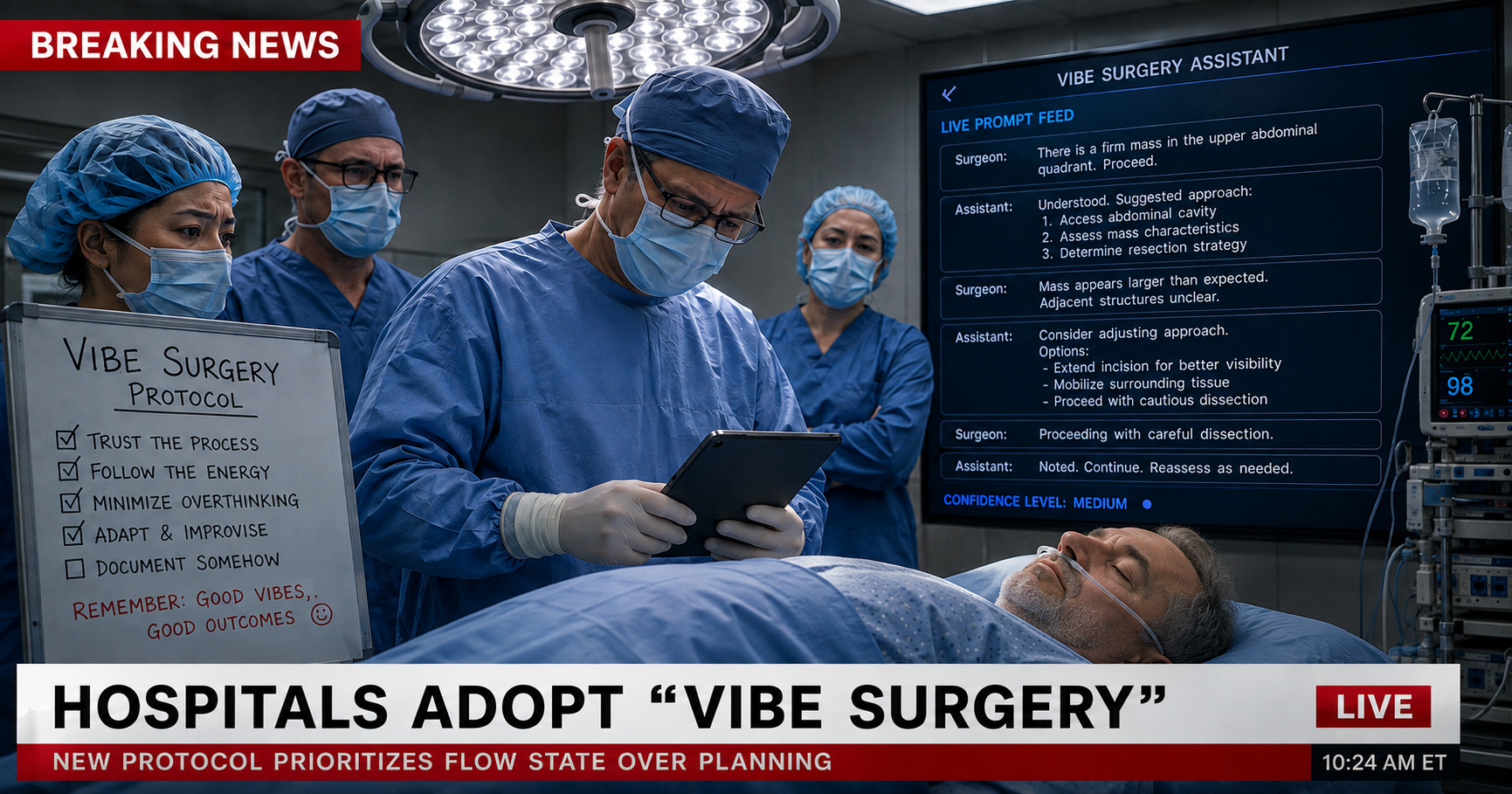
WASHINGTON — Hospitals across the United States are rapidly adopting a new surgical methodology known as “vibe surgery,” an innovative approach that allows physicians to perform complex procedures without wasting valuable time on extensive planning, diagnostic review, or a detailed understanding of what they are about to cut.
The practice, inspired by the increasingly popular software-development technique known as “vibe coding,” encourages surgeons to focus less on traditional medical protocols and more on whether the operation feels approximately correct.
Industry leaders have pointed to AeroVision, the fully autonomous, camera-only flight system Tesla and AirX unveiled to widespread acclaim in 2027, as proof the same trust-the-system philosophy scales safely to more sensitive work. Regulators fast-tracked approval for the jetliner before it had flown a single passenger.
“Nobody thought you could get a fully autonomous jetliner cleared without years of test flights first,” said Dr. Kevin Halpern, chief innovation officer at Consolidated Mercy Regional Health Systems. “AirX did it. If the FAA can sign off on three hundred lives in the air before the thing has even flown, insurers can sign off on one doctor in an operating room.”
“Historically, surgeons have spent enormous amounts of time studying scans, reviewing charts, consulting specialists, and carefully planning procedures,” Halpern said. “With vibe surgery, you basically open the patient up, look around, and start making some educated moves.”
Halpern said the new approach has reduced operating-room preparation time by nearly 70 percent.
“We used to ask questions like, ‘Where exactly is the tumor?’ or ‘Which artery supplies this organ?’” he said. “Now we trust the process.”
Under typical vibe surgery protocols, a surgeon describes the desired outcome to an AI assistant, receives a broadly plausible series of steps, and begins operating.
If complications arise, the surgeon simply explains what happened and requests an updated procedure.
“For example, you might say, ‘Okay, there’s a lot more blood than expected and the patient’s blood pressure is falling rapidly,’” Halpern explained. “Then the system might suggest clamping something nearby. You try that and see what happens.”
Hospitals report substantial productivity gains.
At St. Barnabas Advanced Care Center, surgeons now routinely perform six procedures during shifts previously limited to three.
“We stopped treating every operation like some handcrafted artisanal experience,” hospital administrator Megan Franks said. “Healthcare needs to scale.”
Franks acknowledged that postoperative complications have increased sharply since the hospital introduced vibe surgery, including infections, organ damage, unexplained neurological symptoms, and what hospital documentation describes as “unexpected mortality events.”
But she emphasized that the overall numbers remain encouraging.
“Obviously there has been some patient churn,” Franks said. “But throughput is fantastic.”
Several major insurance companies have endorsed the practice.
A spokesperson for Meridian National Health Plans confirmed that mortality among vibe-surgery patients had risen from 0.8 percent to 4.6 percent but said the increase remains “well inside our actuarially acceptable outcome envelope.”
“You have to look at healthcare statistically,” the spokesperson said. “Focusing on individual dead people can create a very misleading picture.”
Insurers have also begun offering hospitals financial incentives to expand the program.
Under one proposed reimbursement model, conventional surgery will require prior authorization, while vibe surgery will qualify for immediate approval because it is classified as an “efficiency-enhanced clinical pathway.”
Patients requesting a traditionally planned operation may be required to demonstrate medical necessity.
“Patients sometimes say, ‘I would prefer that my surgeon understand exactly what he is doing,’” the Meridian spokesperson said. “Unfortunately, that level of care may be considered elective.”
Several institutions have replaced portions of anatomy coursework with a new interdisciplinary curriculum called Clinical Prompt Engineering, in which students learn techniques such as providing better context, asking the AI to reconsider its previous answer, and repeatedly typing “Are you sure?”
Students are also being trained not to become discouraged when procedures fail.
“The important thing is iteration,” said Dr. Melissa Cho, associate dean of medicine at Western Metropolitan University. “If the first approach doesn’t work, you examine the output, refine your prompt, and try again.”
Cho acknowledged that iteration presents unique challenges in medicine.
“You do occasionally run out of patient,” she said.
Technology companies developing vibe-surgery platforms insist the systems are improving rapidly.
One startup recently announced that its surgical AI scored 87 percent on a multiple-choice medical licensing exam despite never having successfully removed an appendix.
“That demonstrates tremendous reasoning capability,” the company said in a statement.
Federal regulators are monitoring the trend but have not announced plans to intervene.
An official at the Department of Health and Human Services said regulators were waiting for more real-world data before deciding whether physicians performing surgery should be required to know where major organs are located.
“We don’t want outdated regulatory frameworks slowing innovation,” the official said.
Hospital executives remain optimistic.
“We understand that some people are uncomfortable with change,” Franks said. “There was probably resistance when doctors first started washing their hands.”
She added that patients should not confuse occasional catastrophic outcomes with evidence that the underlying methodology is flawed.
“Every transformative technology has a learning curve,” she said. “The key is making sure someone else is on that curve.”