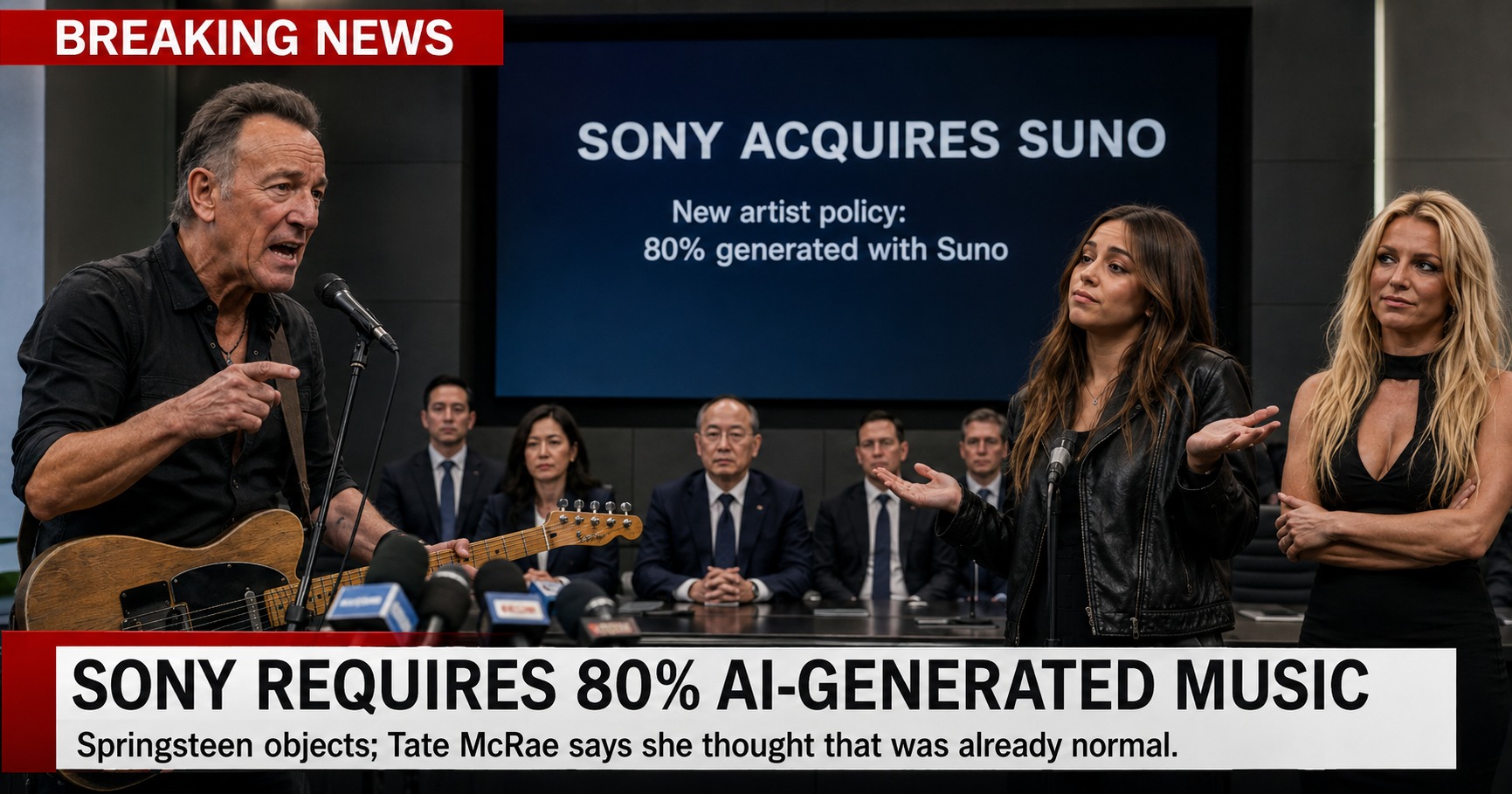
NEW YORK — Sony Music announced Friday that it has acquired AI music-generation company Suno and will require artists across its labels to produce at least 80 percent of all new recorded material using the platform, a policy executives described as “an important investment in the future of human creativity.”
The policy borrows directly from a trend already underway in software, where several major employers have set explicit AI-usage targets for their own staff. Meta has told some engineering teams to generate up to 75 percent of their code using AI tools, Microsoft CEO Satya Nadella has said as much as 30 percent of the company’s code is already AI-written, and JPMorgan Chase has tied AI-tool adoption to performance reviews for roughly 65,000 of its engineers and technologists.
The requirement applies to Sony’s entire roster, including Bruce Springsteen, Britney Spears, Tate McRae, and thousands of other performers who had previously been under the impression that recording contracts involved recording music.
Under the new policy, artists may continue to personally perform up to 20 percent of each album, EP, or single. Sony officials said the remaining 80 percent may be generated by entering a short description of the desired song into Suno.
“We are not replacing artists,” Sony Music CEO Rob Stringer said. “We are allowing artists to concentrate on the uniquely human aspects of being an artist, such as approving cover art, attending promotional events, and selecting which of four generated choruses feels most authentic to their journey.”
The company said artists will retain “meaningful creative control” through access to an expanded prompt field capable of accepting up to 2,000 characters.
Reaction from Sony artists was immediate.
Bruce Springsteen issued a statement calling the policy “an obscenity” and said he would not allow an algorithm to write songs about working people, American decline, lost factories, dead-end towns, or men driving alone at night through New Jersey.
Sony responded that Suno had already generated 14,000 such songs during the time it took Springsteen to prepare the statement.
The dispute escalated after Springsteen reportedly refused to approve a company-generated track titled “Thunder Road Again,” prompting Sony to remind him that the 80 percent requirement was a minimum rather than a target.
“I spent fifty years learning how to write songs,” Springsteen said. “You don’t type ‘sad guy, harmonica, New Jersey, maybe redemption’ into a box and call that a Bruce Springsteen record.”
A Sony spokesperson later confirmed that this was, in fact, very close to the prompt the company had been using.
Tate McRae expressed less concern.
“I thought this was how everybody did it,” McRae said after being informed of the controversy.
Asked to clarify, McRae said she had always assumed albums were created by selecting “female pop, emotionally unavailable boyfriend, huge chorus, sounds expensive” and waiting approximately 45 seconds.
Sony executives said McRae’s transition to the new system was therefore expected to be seamless.
Britney Spears had not released a formal statement as of Friday afternoon, though Sony confirmed that Suno had already completed three Britney Spears albums and was waiting to hear whether Spears wished to participate in any of them.
Music industry groups reacted cautiously to the acquisition.
The Recording Industry Association of America praised the move as a “responsible framework for the next generation of music,” while emphasizing that unauthorized AI companies must still be prevented from training systems on copyrighted recordings without permission.
Sony clarified that this concern no longer applies to Suno because Sony now owns it.
“That was really the central legal issue,” a company attorney explained.
The acquisition is expected to dramatically reduce production costs. According to internal projections, an album that previously required six months of songwriting, studio musicians, producers, engineers, mixing, mastering, and repeated sessions can now be completed during a moderately long lunch.
Artists will still be encouraged to visit studios.
“They’re important culturally,” Stringer said. “People like seeing the pictures.”
Sony also rejected accusations that the 80 percent mandate would make popular music more homogeneous.
To demonstrate Suno’s range, the company played reporters three newly generated songs: an intimate acoustic confession about heartbreak, an explosive synth-pop anthem about heartbreak, and a brooding alternative-rock track about heartbreak.
Executives stressed that all three used different chord progressions.
The company said it eventually hopes to raise the Suno requirement from 80 percent to 95 percent, though executives emphasized that no decision has been made.
“We will always need artists,” Stringer said. “Someone has to tell Suno what kind of song to make.”