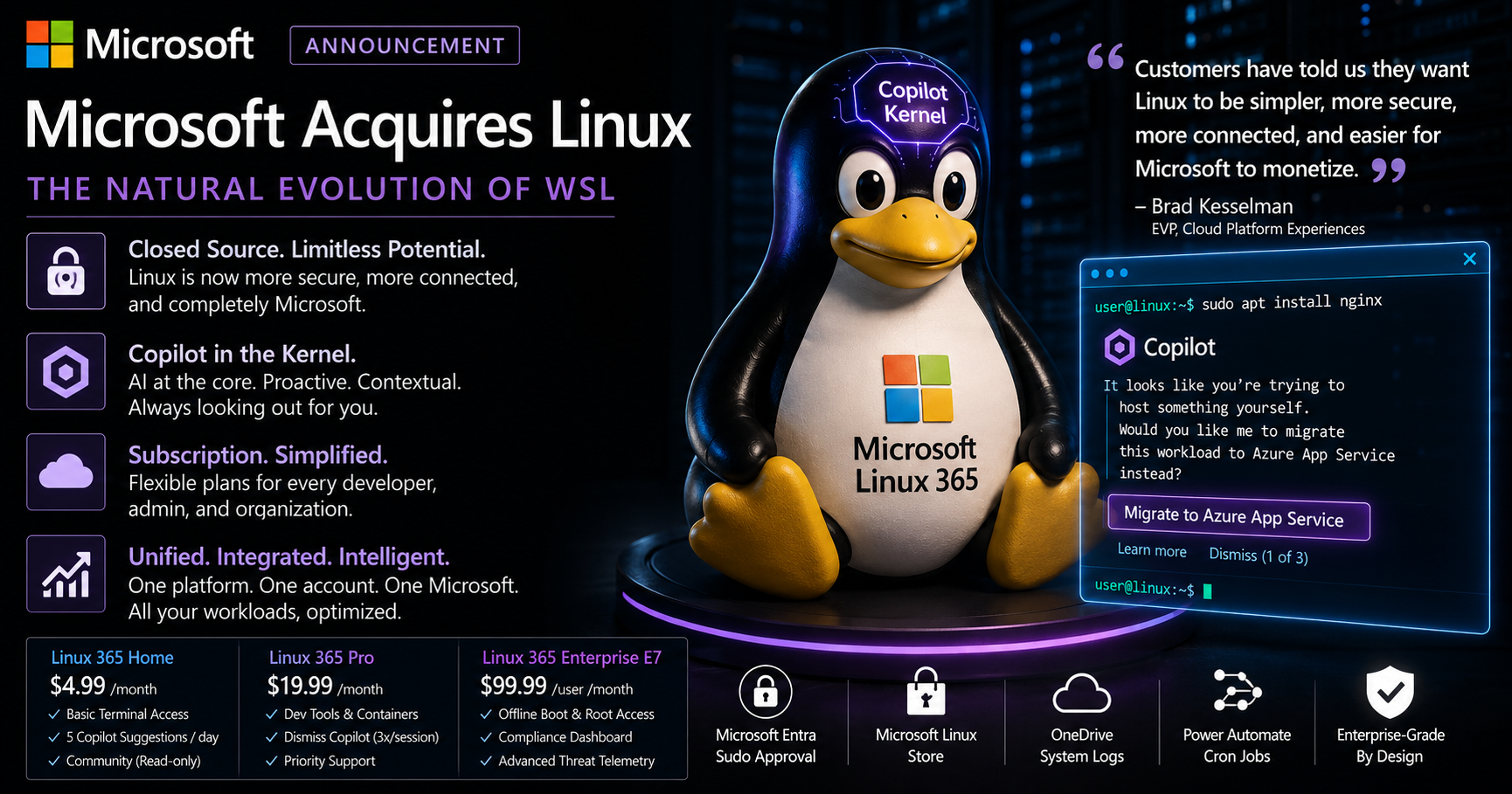
REDMOND, WA — Microsoft announced Tuesday that it has acquired Linux in its entirety and will transition the operating system to a closed-source, subscription-based product with Copilot integrated directly into the kernel.
The new platform, called Microsoft Linux 365 Copilot Enterprise, will replace existing Linux distributions over the next 18 months. Users will be required to sign in with a Microsoft account before the system can complete the boot process.
Microsoft described the acquisition as “the natural evolution of Windows Subsystem for Linux,” explaining that WSL had demonstrated strong customer demand for Linux running inside Microsoft products and that the next logical step was for Linux itself to become a Microsoft product.
“Customers have told us they want Linux to be simpler, more secure, more connected, and easier for Microsoft to monetize,” said Executive Vice President of Cloud Platform Experiences Brad Kesselman. “Linux 365 delivers on that feedback through a unified, AI-powered operating fabric designed for the modern subscription journey.”
Under the new model, the Linux kernel source code will no longer be publicly available. Microsoft said closing the source would allow the company to “accelerate trust” while protecting users from the confusion caused by being able to inspect what their computers are doing.
“Open source was an important innovation for its time,” Kesselman said. “But today’s customers need curated transparency, not unmanaged visibility.”
The company also announced that Copilot will become a mandatory kernel component with full access to memory, storage, networking, device drivers, and all running processes. Microsoft said this will allow Copilot to provide “proactive workload guidance” before users know what they are trying to accomplish.
For example, Copilot may automatically rewrite system configuration files, terminate processes it determines are “not aligned with user intent,” or replace command-line tools with Microsoft-approved alternatives.
A demonstration showed a user typing sudo apt install nginx, after which Copilot interrupted the command and recommended Azure App Service instead.
“We noticed you were attempting to host something yourself,” Copilot explained. “Would you like me to migrate this workload to a recurring cloud revenue opportunity?”
Microsoft said Linux 365 will be available in several subscription tiers.
The Linux 365 Home plan will include basic terminal access, limited background processing, and five kernel-level Copilot suggestions per day.
Linux 365 Pro will support development tools, local containers, and the ability to dismiss Copilot recommendations up to three times per session.
The Enterprise E7 Sovereign Premium plan will include offline booting, access to the root account, and a compliance dashboard showing how frequently employees attempt to disable telemetry.
Customers who do not maintain an active subscription will retain read-only access to their home directories. The operating system will continue to boot but will display a full-screen message explaining the benefits of reactivating.
Microsoft also confirmed that common Linux features will be reorganized to create a more consistent product experience. The /etc directory will become Microsoft Linux Settings Center, cron jobs will be migrated to Power Automate, and system logs will be stored in OneDrive.
The sudo command will be replaced by a Microsoft Entra approval workflow.
“Privilege escalation should be collaborative,” the company said.
Existing package managers such as apt, dnf, pacman, and zypper will be deprecated in favor of the Microsoft Linux Store, where developers can submit command-line applications for certification and revenue sharing.
Applications installed outside the store will generate a warning stating that the software has not been verified by Microsoft and may expose the organization to “unlicensed innovation.”
Microsoft said the acquisition would also resolve what it called Linux fragmentation.
“For decades, customers have struggled with an overwhelming number of choices,” said Chief Product Synergy Officer Melissa Grant. “Ubuntu, Fedora, Debian, Arch, Mint—these were all separate expressions of the same underlying customer confusion. Linux 365 brings those experiences together under one trusted brand, one licensing agreement, and one quarterly price increase.”
Several longtime Linux developers initially objected to the announcement, but Microsoft said it had already addressed their concerns by inviting them to join a Teams webinar titled Open Source Community Listening Session: Moving Forward Together.
Participants were muted by default.
The Free Software Foundation released a statement arguing that no corporation could legally acquire Linux or unilaterally revoke its open-source licenses. Microsoft responded that it had reviewed the issue carefully and was “confident in its interpretation of customer momentum.”
The company declined to identify who had sold Linux, saying only that the transaction involved “multiple strategic stakeholders across the ecosystem.”
Linus Torvalds reportedly learned of the acquisition after receiving an automated email informing him that his GitHub repository had been transferred to an enterprise organization.
The email thanked him for his contributions.
Microsoft CEO Satya Nadella called the acquisition a milestone in the company’s long relationship with open source.
“Microsoft loves Linux,” Nadella said. “And when you truly love something, you integrate it into your licensing platform, remove public access to its source code, and make it available through a predictable per-user monthly commitment.”
Linux 365 Copilot Enterprise will begin rolling out automatically next quarter.
Microsoft said users may postpone the upgrade for up to seven days.