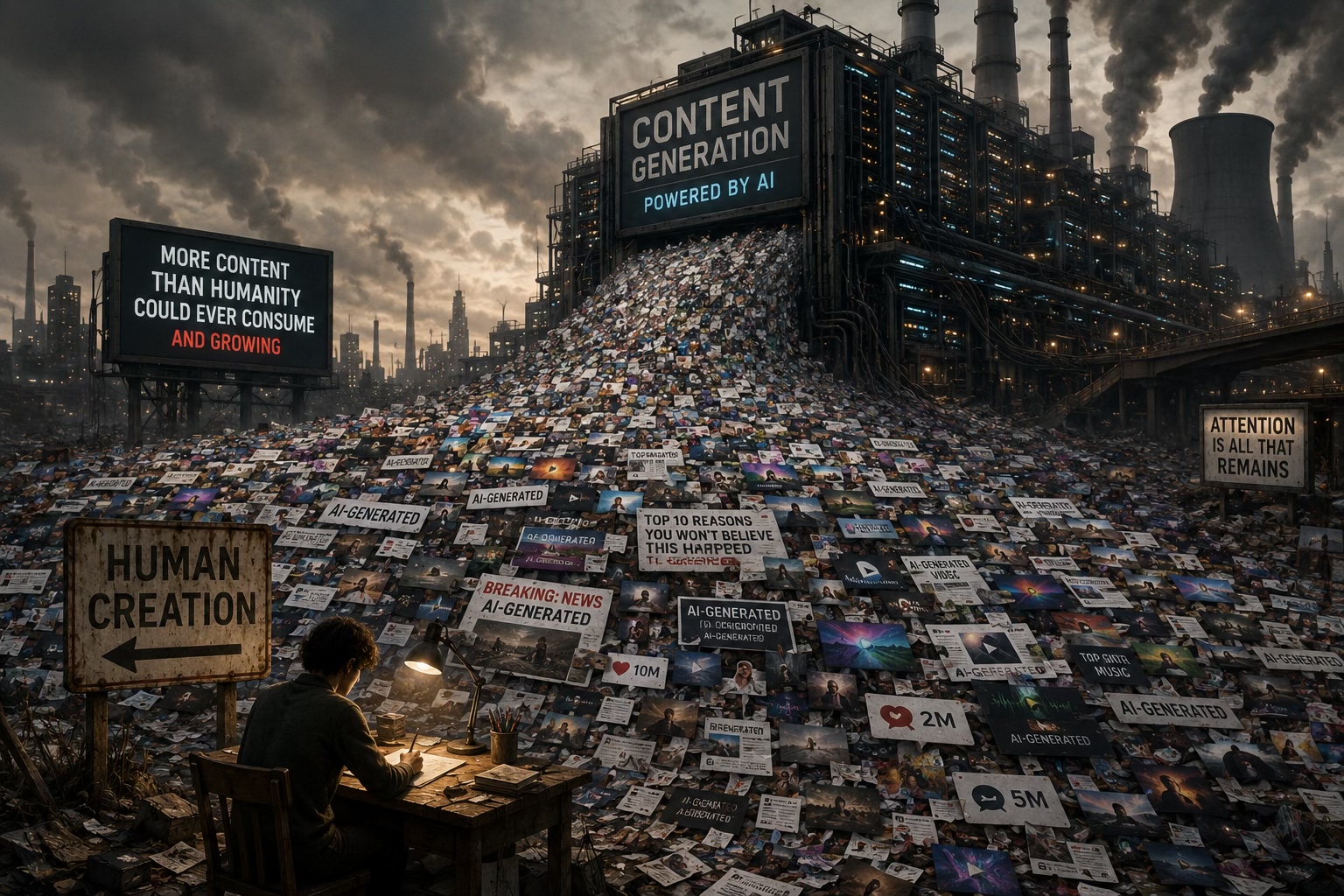
The first indication that civilization had entered its final stage was a press release.
FOR IMMEDIATE RELEASE Today, humanity achieved a historic milestone by publishing one quadrillion pieces of content in a single day. Experts agree this represents an unprecedented flowering of human creativity.
The press release had been written by AI. So had the 4.8 million articles praising it.
Within a year, nobody made software anymore. They made prompts that made prompts that made software. The software usually didn’t work. This wasn’t considered a bug—it was called iterative innovation. Software companies proudly advertised: “Now shipping 800% more code!” Nobody mentioned that none of it had been executed before deployment.
The music industry solved originality. Every listener received brand-new songs generated specifically for their mood, weather, heart rate, political opinions, blood sugar, and recent grocery purchases. People listened once. Never again. Spotify announced customer satisfaction had reached an all-time high because no one could remember enough of a song to dislike it.
Hollywood celebrated the end of artistic compromise. Every film adapted itself in real time. Didn’t like the ending? Changed. Didn’t like the hero? Different hero. Didn’t like dialogue? No dialogue. Didn’t like movies? Congratulations—you were now watching an eight-hour documentary about someone else who also didn’t like movies. Every film won an award. None were remembered by Tuesday.
News organizations entered what analysts called the Post-Factual Velocity Economy. Waiting for events had become inefficient. They reported what was statistically likely to occur. Reality often failed to cooperate. Corrections were unnecessary because replacement articles generated every twelve seconds. History became a software update.
Social media finally eliminated loneliness. Every citizen was assigned three hundred emotionally supportive AI followers. Unfortunately, each follower was assigned three hundred more. By 2034, ninety-eight percent of internet traffic consisted of bots congratulating one another on authentic engagement. Shareholders were delighted.
Then came electricity.
The National Grid issued a helpful reminder: “Please avoid unnecessary power consumption between 6 PM and 11 PM.” Citizens obediently turned off lights. Refrigerators. Air conditioners. Medical equipment where practical.
Across town, a newly opened AI campus consumed roughly the same electricity as Portugal while generating inspirational LinkedIn posts about sustainability.
Prices doubled. Economists explained this was good news—higher prices encouraged innovation. Families innovated by eating dinner in the dark. Children innovated by charging tablets at school. Hospitals innovated by postponing surgeries until windy days. The data centers continued innovating twenty-four hours a day.
Coal plants reopened. Not because of an energy crisis—that would have sounded negative. Officially, they were participating in a Legacy Carbon Infrastructure Revitalization Initiative. Ribbon-cutting ceremonies featured executives standing directly upwind.
The air quality index was quietly renamed. Instead of “Hazardous,” weather apps displayed: Atmospherically Rich. Children were advised not to exercise outdoors unless wearing an N95 mask or a sufficiently optimistic attitude.
Computer memory became surprisingly expensive. Not because of a silicon shortage. Because every chip on Earth had been pre-ordered by companies training models to explain why memory had become expensive.
Consumers celebrated a revolutionary new one-terabyte SSD. Suggested retail price: $18,499. Financing available.
A 64-gigabyte USB stick became an heirloom. Grandparents passed them down in wills. “I leave little Emma the Kingston.” The funeral guests nodded respectfully, knowing she would never afford one herself. That tiny sliver of plastic held more real data—photographs, letters, a single uncompressed song—than most people would touch in a lifetime. The rest lived in the cloud. The cloud lived in data centers. The data centers lived on credit.
Search engines eventually admitted defeat. Typing a question no longer searched the internet—it generated an internet that probably contained the answer. Users reported dramatic improvements in relevance. Reality reported declining market share.
Scientists studying climate change encountered an unexpected obstacle. Every genuine paper was immediately buried beneath 18,000 AI summaries, 240,000 explainers, 7 million reaction videos, and one podcast titled Let’s Unpack This. The original research ranked 9,842,311th in search results.
The last independent musician uploaded an album. It disappeared beneath forty-three million AI-generated “albums inspired by the emotional geometry of the original.” Streaming services congratulated everyone involved.
The last investigative journalist spent eight months exposing corruption. Her story was buried beneath sixteen billion listicles titled You Won’t Believe What This Senator Did Next! He had attended a zoning meeting.
The final human programmer retired. Asked whether he regretted leaving, he shrugged.
“I used to spend six months designing a reliable distributed system.”
“What happened?”
“Now an AI generates twenty-seven before breakfast.”
“That sounds faster.”
“Oh, it’s much faster.”
“Is it better?”
He stared for a long time. “That’s no longer considered a business metric.”
The atmosphere warmed. The oceans rose. The skies turned brown again. Coal trains rolled past solar farms that had been disconnected to reserve transmission capacity for nearby inference clusters. The clusters produced thousands of beautiful illustrations depicting pristine forests. People clicked “Like.”
The final announcement came on an unusually hot afternoon.
Every phone buzzed simultaneously.
🎉 Congratulations! Humanity has officially produced more content today than all previous generations combined. To celebrate this historic achievement, your electricity has been disconnected until Tuesday. Please enjoy one of our personalized motivational videos while your device still has battery.
The video began immediately. An AI-generated woman smiled reassuringly from an AI-generated forest beneath an AI-generated blue sky.
“Remember,” she said, “creativity has never been more accessible.”
The screen dimmed. The lights went out.
Outside, the heat didn’t care. The coal smoke didn’t care. The glaciers, already gone, certainly didn’t care.
Somewhere beyond the horizon, another data center came online—its processors already generating twelve million heartfelt essays mourning the loss of authentic human creativity. Each essay was immediately liked, shared, and replied to by bots that had never known a world without slop.
In the darkness, a child reached for a drawer. Inside lay a 64-gigabyte USB stick, inherited from a grandmother who once took photographs of real sunsets.
The child held it.
There was nothing left to plug it into.