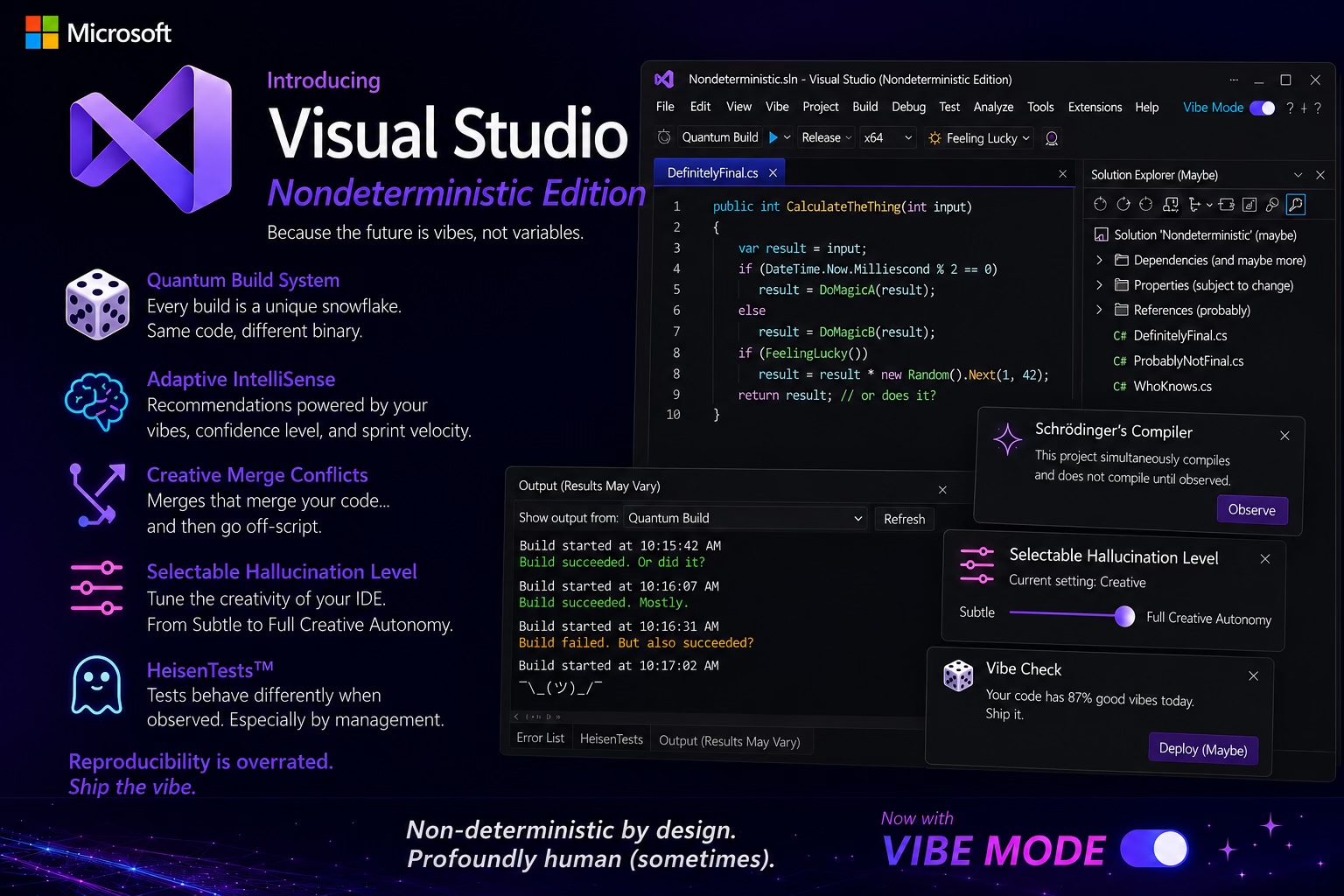
REDMOND, Wash. — Microsoft today announced Visual Studio Nondeterministic Edition, a major redesign of its flagship IDE intended to “align the development environment with the inherently creative nature of modern AI-assisted software engineering.”
According to Microsoft, the new release intentionally produces different results each time the same operation is performed.
Building the same commit twice may generate different binaries. Refactoring the same method twice may produce two unrelated implementations. Running unit tests repeatedly can yield entirely new categories of failures that were not previously observed.
Company executives described the behavior as “an authentic extension of the AI-native workflow.”
“For too long, developers have been constrained by deterministic tooling,” said one product manager during the launch event. “Modern software isn’t about repeating the past. It’s about discovering new possibilities every time you press F5.”
Among the new features are:
- Quantum Build System randomly optimizes portions of the codebase based on “overall project vibes.”
- Adaptive IntelliSense changes API recommendations depending on developer confidence and current sprint velocity.
- Creative Merge Conflicts generate entirely new implementations that neither branch originally contained.
- Selectable Hallucination Level™ lets developers choose how imaginative the IDE should become, with settings ranging from Subtle to Full Creative Autonomy.
- HeisenTests™ automatically pass whenever a developer begins screen sharing.
The release also includes Schrödinger’s Compiler, which allows code to simultaneously compile and fail until the build log is opened.
Microsoft engineers acknowledged that reproducible builds are no longer supported.
“We found that reproducibility was discouraging experimentation,” one engineer explained. “Now every deployment is a unique experience.”
The company also announced that future versions of Copilot will automatically increase the hallucination level as project deadlines approach, explaining that “confidence is a critical productivity metric.”
Security researchers initially expressed concern after discovering identical source code frequently produced different machine instructions.
Microsoft clarified that this behavior significantly improves cybersecurity.
“If attackers can’t predict what the compiler will generate,” the company said, “neither can defenders. This restores balance.”
Industry analysts believe the release completes Microsoft’s transition from traditional software engineering toward what executives now call “probabilistic craftsmanship.”
Developers who participated in the preview program reported spending considerably less time asking whether their code was correct and considerably more time asking whether the previous successful build had actually existed.
Microsoft confirmed that support engineers will no longer investigate bug reports unless customers can reproduce them at least three different ways, noting that a single reproduction “may simply represent one valid interpretation of the software.”
The company concluded the announcement by assuring customers that every copy of Visual Studio Nondeterministic Edition is thoroughly tested, although each installation uses a different test suite and may therefore receive different results.
When asked whether the new IDE would be suitable for safety-critical software, Microsoft responded that the answer “depends on the currently selected hallucination level.”