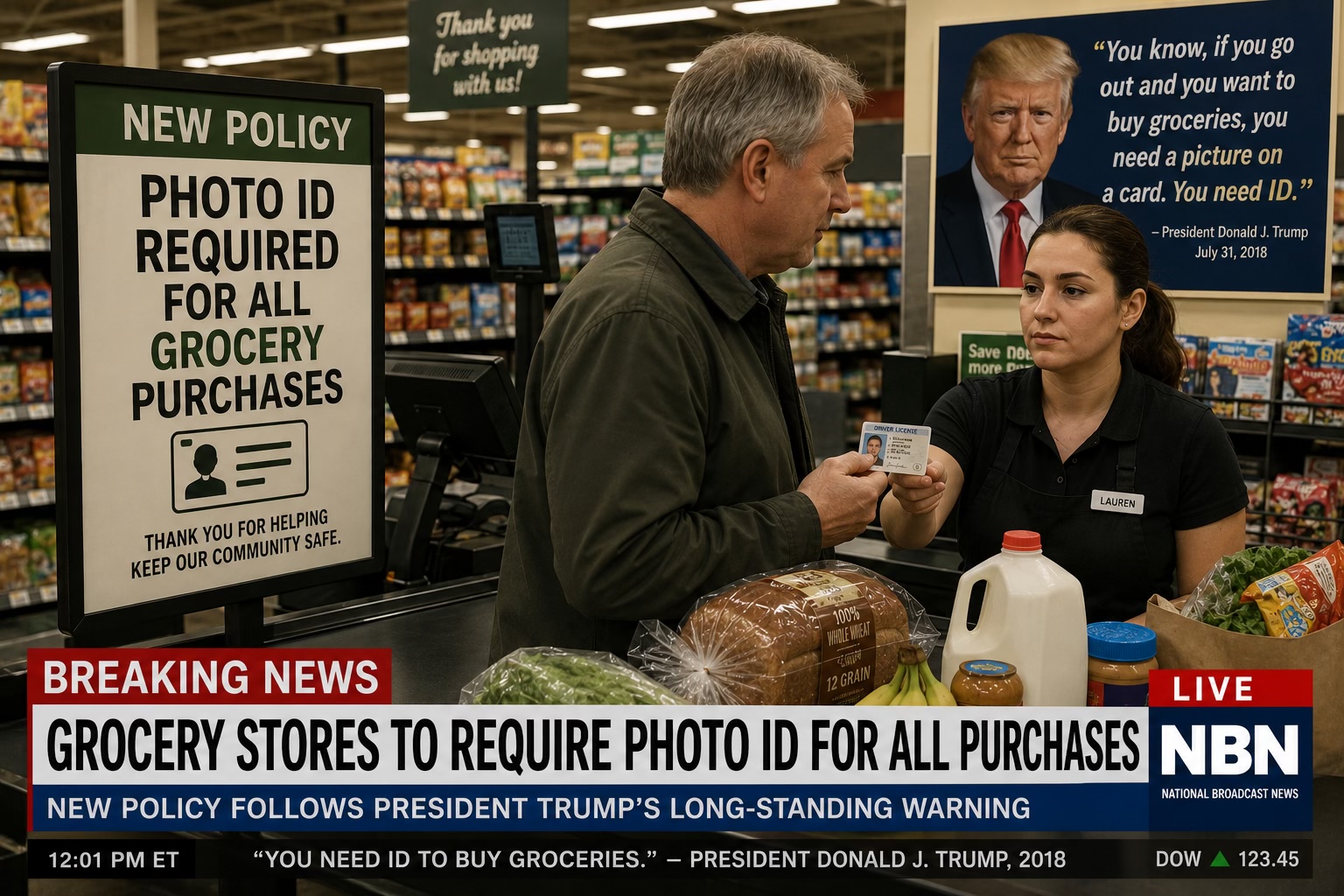
WASHINGTON — Eight years after President Donald Trump warned that Americans already needed photo identification to buy groceries, the nation’s largest grocery chains announced Wednesday that they will finally begin enforcing the policy.
Industry executives described the move as “long overdue.”
“When President Trump said you need ID to buy groceries, many people mistakenly believed he was describing a policy that didn’t exist,” National Grocery Retail Federation spokesperson Karen Whitlock said. “In hindsight, he was simply ahead of the industry.”
Beginning next month, customers purchasing any item at a participating grocery store, including bread, produce, dairy, canned goods, frozen meals, and snacks, must present a valid government-issued photo ID before the sale can be completed.
Retailers say the new Grocery Verification Program will close a dangerous gap that has allowed Americans to obtain food with virtually no accountability.
“For decades, anyone could walk into a supermarket and anonymously purchase a dozen eggs,” Whitlock said. “Looking back, it’s difficult to believe we allowed that.”
Under the new procedures, cashiers will compare the customer’s face to their identification before scanning a single item, regardless of category.
Customers purchasing unusually large quantities of any product may be asked routine follow-up questions, including whether the groceries are intended for personal consumption, family use, or a suspiciously large gathering.
A centralized National Grocery Integrity Database will also be established to prevent customers from purchasing groceries at multiple stores under different identities.
Officials emphasized that the database is not intended to track ordinary Americans.
“It simply records who purchased what, where, when, how often, and in what quantity,” Whitlock explained.
The system will automatically flag unusual purchasing behavior, including buying paper towels immediately after purchasing paper towels somewhere else, or repeatedly claiming to need “just one more thing.”
Self-checkout lanes will receive software updates requiring customers to scan both their groceries and their driver’s license for every item in the cart, not only the first one.
If the photographs do not appear to match, the register will lock until a Grocery Compliance Associate arrives to verify the customer’s identity.
Store employees have already begun specialized training.
“They’re learning to identify common indicators of grocery fraud,” one training manual explains. “These include avoiding eye contact, buying more than one kind of milk, and claiming the groceries are ‘for a friend.’”
Asked why such measures were necessary when documented cases of grocery impersonation are essentially nonexistent, grocery executives said that only proved how urgently stronger safeguards were needed.
“The absence of grocery fraud demonstrates the effectiveness of policies we hadn’t implemented yet,” Whitlock said.
President Trump welcomed the announcement, calling it “a beautiful day for the American shopper.”
“I told people years ago you needed ID to buy groceries,” Trump said. “Everybody laughed. Now they’re all doing it. Frankly, the grocery stores owe me an apology.”
White House Press Secretary Karoline Leavitt credited the President’s leadership for the change. “While the media mocked him for years, President Trump was simply ahead of his time,” Leavitt said. “This is what strong, decisive leadership looks like.”
Walmart and several other major retailers said they are reviewing whether to extend the policy beyond groceries. “The President was very clear that you need ID to buy anything, not just groceries,” a Walmart spokesperson said. “We take that seriously.”
Industry analysts expect similar identification requirements to follow at gas stations, pharmacies, and hardware stores, noting that the same 2018 remarks that first raised the grocery issue also specified that Americans need ID “to buy anything.”
Self-service coffee remains under review.