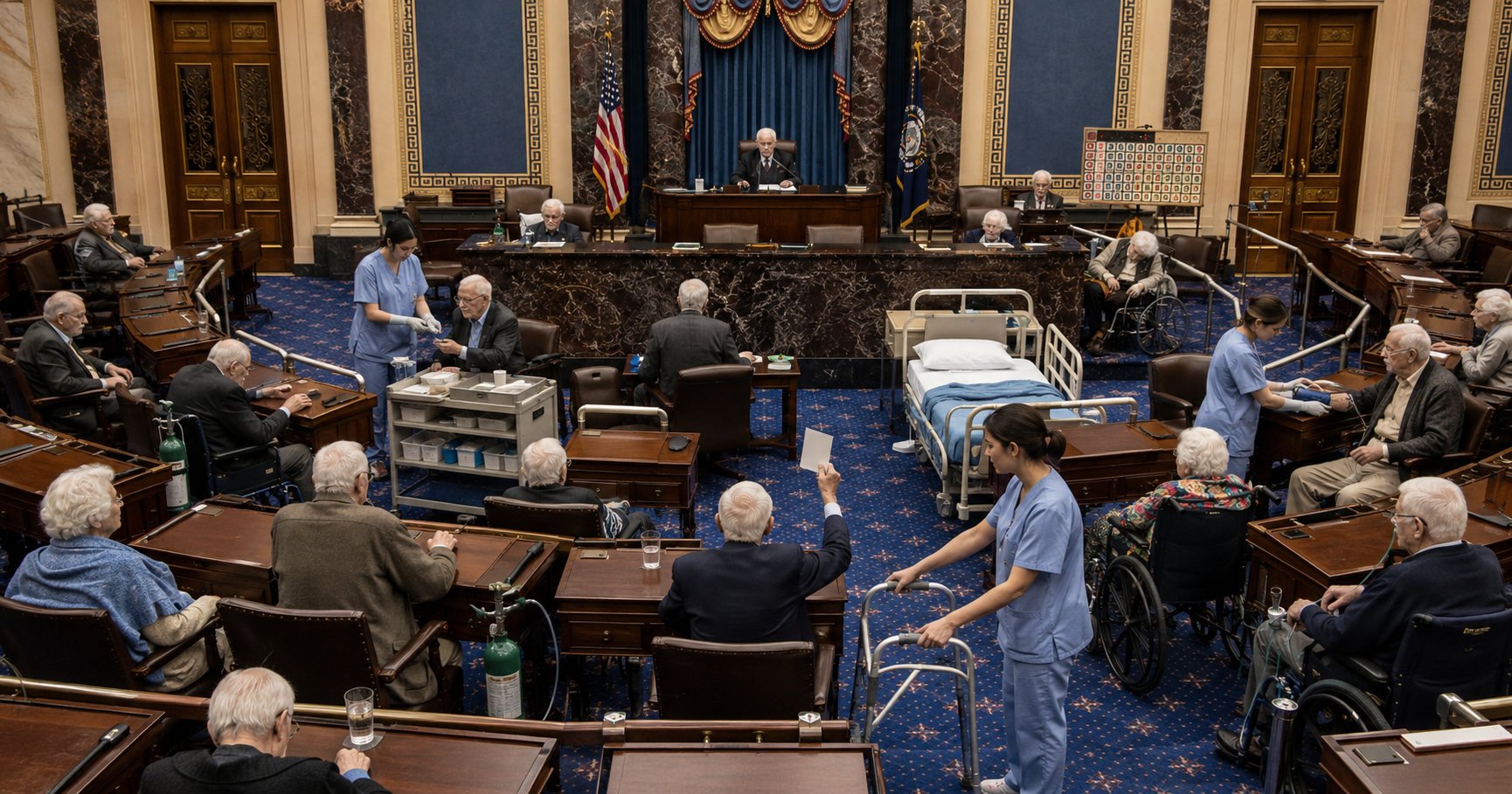
WASHINGTON — Congressional leaders announced Monday that the United States Senate will be converted into a full-service elder care facility, formalizing a function the chamber has performed unofficially for several decades.
Under the renovation plan, the Senate floor will retain its familiar desks, ceremonial carpeting, and atmosphere of profound confusion, but will add handrails, medication carts, adjustable beds, and several nurses trained to explain where everyone is and why the television cameras are there. Presiding over the chamber, as he has for decades, will be Senate President Pro Tempore Chuck Grassley, 92, who aides say requires only a brief pause most mornings to recall which decade it currently is.
“This is not a change in mission,” a Senate spokesperson said. “It is simply an acknowledgment of our existing population and infrastructure.”
The chamber will be renamed the United States Senate and Advanced Memory Care Center, although aides stressed that residents will still be permitted to vote on legislation during lucid intervals.
Committee hearings will now begin with a wellness check, followed by roll call, blood-pressure monitoring, and a brief reminder of which country is currently being discussed. Senators wishing to filibuster must first demonstrate that they can remain standing without assistance.
The Senate dining room will introduce a new menu featuring low-sodium soup, gelatin cups, and individually labeled containers of pudding that residents will continue accusing one another of stealing.
To preserve tradition, all care will be administered according to Senate procedure. Emergency assistance will require unanimous consent, while requests to use the restroom may be filibustered indefinitely by any senator who simply refuses to stop talking.
The facility’s newly commissioned rehabilitation wing already has its first occupant. Sen. Mitch McConnell, 84, moved in over the summer following a fall and is said to be adjusting well, though colleagues report he has already filed for unanimous consent twice, once for a second pudding cup and once to lower the thermostat. Staff released a proof-of-residency photo showing McConnell holding that morning’s activity calendar, though several senators questioned why he was not also holding an IV pole, and one aide’s description of a “warm, detailed” conversation with him could not be corroborated by any recording, transcript, or third party. Facility spokespeople said questions about his continued presence would be answered in due course, provided due course could first secure unanimous consent.
Leadership positions will remain unchanged. The majority leader will continue deciding which activities reach the floor, including appropriations bills, judicial confirmations, bingo, and the weekly screening of Matlock.
The conversion has received bipartisan support, largely because no senator could remember which party originally proposed it.
Not everyone embraced the change without complaint. Sen. Bernie Sanders, 84, denounced the renovation as an insufficient half-measure, arguing that adjustable beds and unlimited pudding should be a universal right guaranteed to every American, not just United States senators.
Critics questioned whether residents of an elder care facility should retain the authority to regulate artificial intelligence, cybersecurity, reproductive medicine, and technologies invented after the fax machine.
Senators rejected the concern.
“We possess something young people do not,” one lawmaker said before pausing for nearly a minute. “Seniority.”
The Congressional Budget Office estimates the conversion will save taxpayers millions by combining legislative operations, assisted living, and end-of-life care under one roof. Costs may rise, however, if the Senate continues insisting that every resident receive a personal staff of 40.
The House of Representatives is not included in the plan. Officials say that chamber will instead be converted into a supervised day-care center.