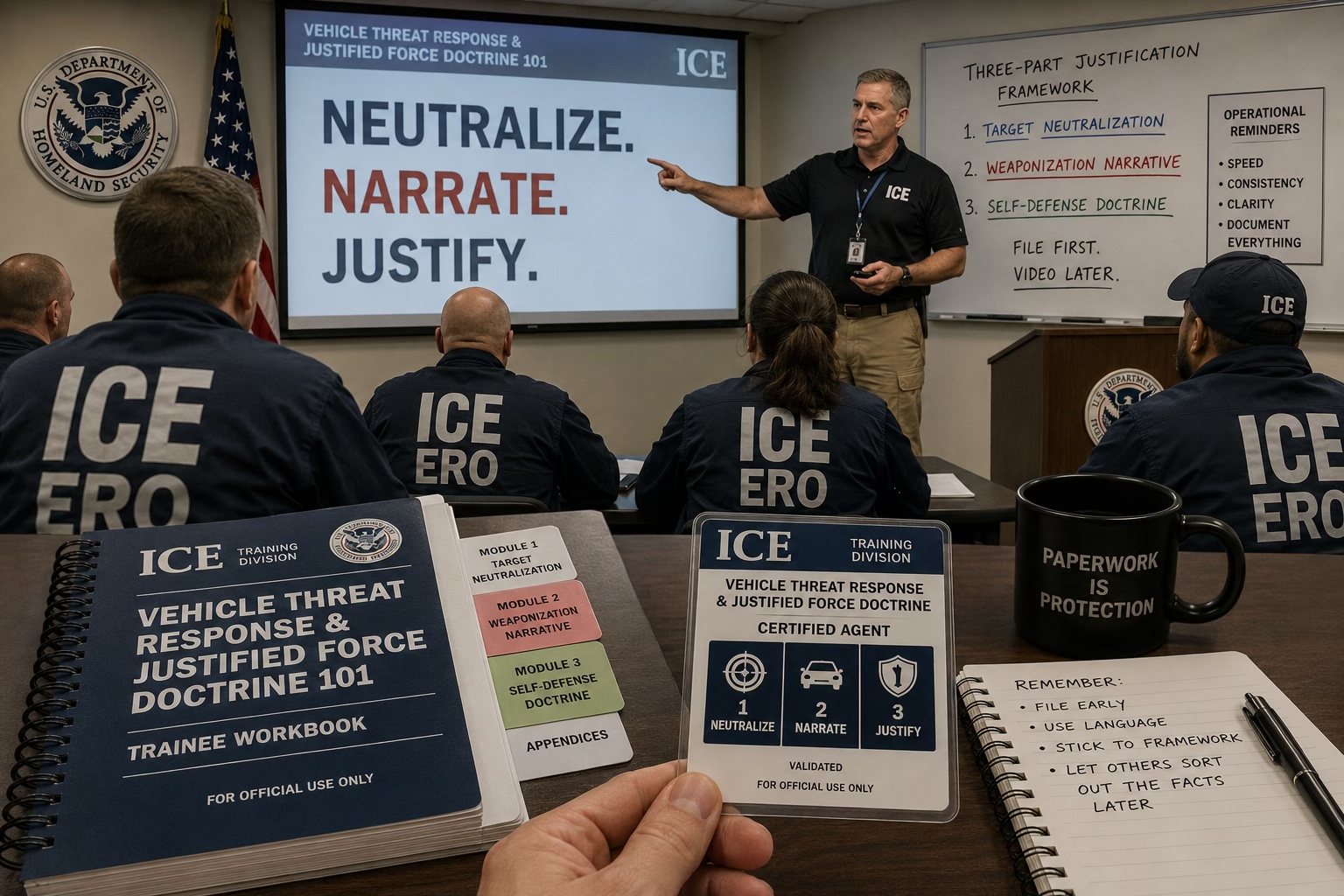
The Daily Farce obtained the following release ahead of its scheduled distribution.
FOR IMMEDIATE RELEASE U.S. Immigration and Customs Enforcement, Office of Public Affairs
ICE ANNOUNCES VEHICLE THREAT RESPONSE AND JUSTIFIED FORCE DOCTRINE CERTIFICATION COURSE Standardized training addresses rising operational tempo; agency reports measurable gains in reporting consistency and turnaround time
WASHINGTON — U.S. Immigration and Customs Enforcement today announced a mandatory certification course standardizing the agency’s vehicular threat resolution methodology across all field offices. The course, internally titled Vehicle Threat Response and Justified Force Doctrine 101, is organized into three modules, an appendix, and a two-page glossary, and concludes with a certification assessment. A fourth module, addressing public communication sequencing in the six hours following a resolution event, is in development.
“The course exists to standardize terminology and reporting sequence across the agency,” said Regional Training Coordinator Dale Ferrick. “Prior to this course, field offices were each developing their own documentation language independently. That created inconsistency.”
The course responds to volume. According to a Wall Street Journal analysis, agents have fired at or into civilian vehicles in at least 13 separate incidents since July 2025. Caseload is expected to rise further: in May 2025, White House aide Stephen Miller and then-Homeland Security Secretary Kristi Noem directed ICE leadership to reach a minimum of 3,000 arrests per day, and by July 2026 field offices had moved to seven-day operating schedules, with roughly 80 percent of officers assigned to active arrest operations.
“We built this around throughput, not individual incidents,” Ferrick said. “The course is designed around the overall rate, not any one case.”
KEY TERMINOLOGY
The workbook’s glossary defines several terms used throughout the course. A resolution event is “any field encounter in which lethal force is applied to a vehicle occupant.” Subject ambiguity is “a temporary discrepancy between the individual named in an operative warrant and the individual present at a resolution event, typically resolved through subsequent administrative review.” A documentation lag is “the interval between a resolution event and the release of video or witness material inconsistent with the agency’s initial account.”
MODULE 1: TARGET NEUTRALIZATION
Module 1 addresses pre-resolution identity confirmation, and clarifies that confirmation is not a precondition for resolution. “The operative warrant identifies a subject by name,” Ferrick said. “The vehicle present at the scene may or may not contain that subject. The course reframes that discrepancy as a matter for post-resolution administrative determination.” Trainees complete an exercise in which they practice completing incident paperwork before subject ambiguity has been resolved, graded on completion time.
MODULE 2: ESTABLISHING THE WEAPONIZATION NARRATIVE
Module 2 trains agents in narrative sequencing: ensuring specific language enters the official record before independent documentation exists. “The word ‘weaponized’ should appear in the initial statement,” Ferrick said. “Once it is part of the record, subsequent material is evaluated against it rather than replacing it. Sequencing is the entire discipline.” Case studies include the July 7 resolution event involving Lorenzo Salgado Araujo in Houston, in which officials said he “rammed a government vehicle and tried to run over an officer,” and the July 13 resolution event involving Johan Sebastián Durán Guerrero in Biddeford, Maine, in which Homeland Security Secretary Markwayne Mullin stated that the vehicle “had been used as a weapon.” “Both statements were issued independently, in different states, by agents with no contact with one another,” Ferrick said. “The similarity in language reflects shared training materials distributed prior to this course’s formal adoption.”
MODULE 3: INVOKING SELF-DEFENSE DOCTRINE
Module 3 addresses threat perception documentation, instructing agents to record the officer’s subjective assessment of danger independent of the vehicle’s physical trajectory. “Trajectory is one input,” Ferrick said. “It is not the determining input. The determining input is the officer’s documented perception at the time.” The case study is the January 7 resolution event involving Renée Good in Minneapolis, in which officials said she “used her SUV as a weapon and attempted to run over an officer.”
CERTIFICATION AND EARLY RESULTS
Agents completing all three modules receive a laminated wallet card and four continuing-education credits, which the agency said “remain on file.”
ICE reported a 63 percent reduction in median time between a resolution event and the issuance of a public statement, from just over six hours to under forty minutes. “That’s the kind of improvement you want to see,” a spokesperson said. “It reflects better training, better preparation, and a workforce that understands the framework well enough not to need extra time to apply it.”
The agency also reported a sharp reduction in variance across field offices’ initial public statements, from a coefficient of 34 percent in the twelve months before the course was adopted to 6 percent since. “Consistency isn’t a stylistic preference,” the spokesperson said. “It’s a quality-control metric. When two independent offices produce materially different accounts of similar events, that’s a defect. We’ve engineered the defect out.”
###
About ICE: U.S. Immigration and Customs Enforcement is the federal agency responsible for enforcing immigration law within the United States.
Editor’s note
The release does not mention that passengers in the van during the Houston incident disputed DHS’s account, telling reporters the shots came from the side of the vehicle rather than from in front of it, or that bystander video of the Minneapolis incident showed Good’s SUV wheels turned away from officers and toward traffic at the moment the agent fired. Asked about that footage, Ferrick said it “represents a documentation lag. It does not represent a correction to the record. Once a threat-perception statement is entered, it remains the operative account regardless of subsequent material.”
Also absent from the release: in ongoing litigation over enforcement operations in Los Angeles, the Department of Justice has told courts that no formal arrest quota exists. Asked to reconcile that filing with the agency’s own internal targets, Ferrick said the two statements were “not in conflict.”
“A quota and an operational target are documented differently,” he said. “The distinction is addressed in the appendix.”
Asked whether the course had reduced the number of vehicle-stop resolution events, Ferrick said that was not a metric the course was designed to affect. “It is a documentation-standardization initiative,” he said. “Those are separate metrics, evaluated separately.”
Since July 2025, agents have fired at or into civilian vehicles in at least 13 documented incidents, wounding at least eight people, two of them fatally. At least five of the eight wounded were U.S. citizens. The figure appears nowhere in the release. ICE has not said how many of the agents involved had completed the course.