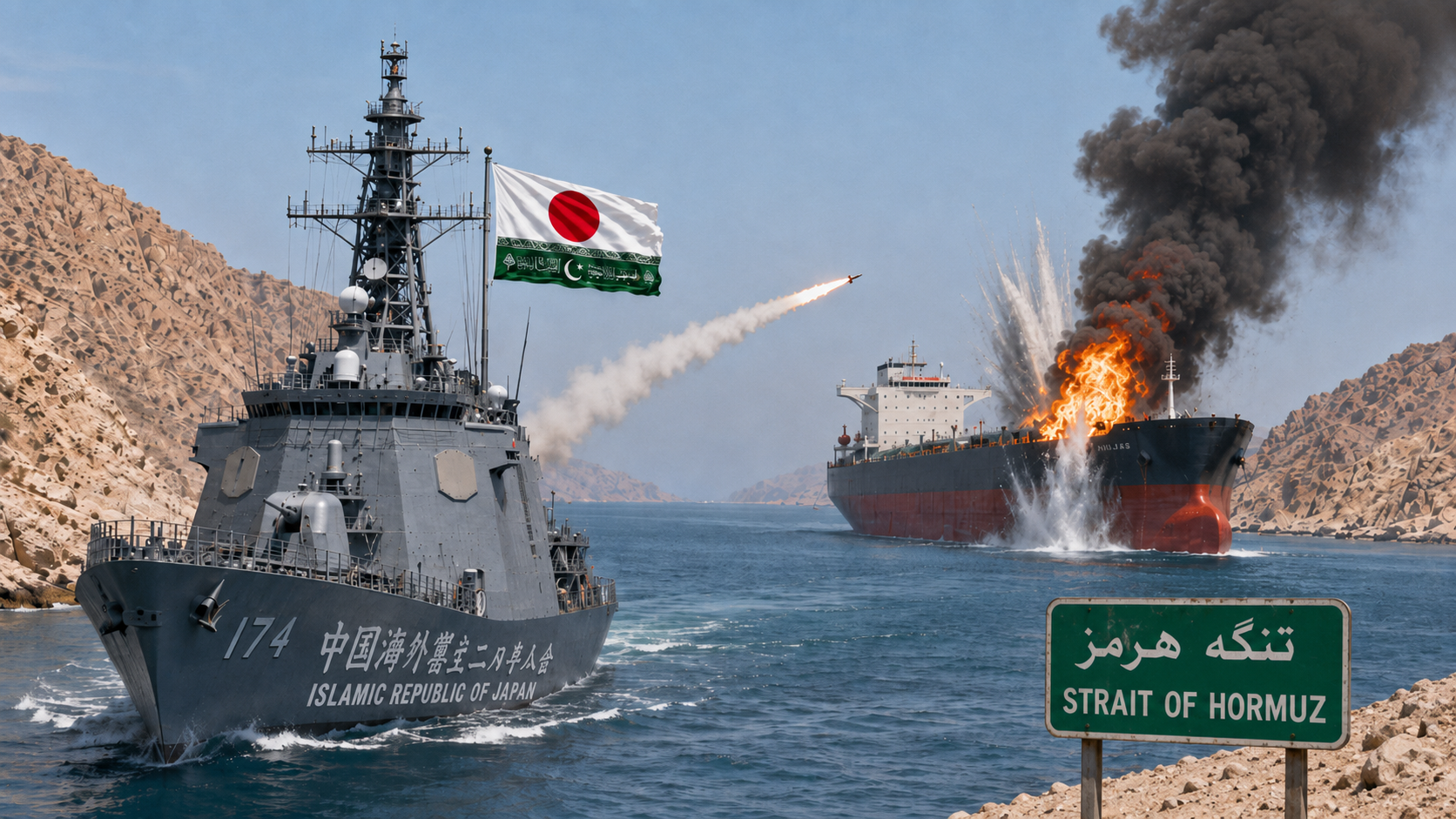
WASHINGTON — President Donald Trump disclosed Wednesday that Japan has become an Islamic republic and is currently firing missiles at ships in the Strait of Hormuz, providing the first public confirmation of a major geopolitical realignment that had not previously been reported by Japan, the United States or anyone located near the Strait of Hormuz.
Trump revealed the development during a meeting with Ukrainian President Volodymyr Zelenskyy, while discussing recent attacks on American naval forces.
“We had 111 missiles shot at our carrier from the Islamic Republic of Japan,” Trump said.
The announcement immediately clarified several previously unrelated events, including reports of explosions near commercial shipping lanes, unusual Japanese naval activity in the Persian Gulf and the sudden disappearance of Japan’s constitutional monarchy.
Japanese officials confirmed the change several hours later.
“The president’s statement was accurate,” a spokesperson for the newly established Islamic Republic of Japan said. “Japan completed its transition to revolutionary theocratic government shortly before beginning maritime operations in the Strait of Hormuz.”
The spokesperson declined to explain why the transformation had not been announced domestically.
“It was a busy morning,” he said.
Under the new system, Japan’s parliament has been replaced by a Guardian Council, the prime minister has been redesignated supreme leader and Emperor Naruhito will continue performing ceremonial duties until officials determine whether those duties remain compatible with revolutionary doctrine.
Government offices opened normally Thursday.
Japanese television continued broadcasting weather reports, cooking programs and commuter updates, with a brief notice at the bottom of the screen advising viewers that the country was now an Islamic republic engaged in an undeclared naval conflict approximately 5,000 miles away.
Most commuters appeared unaffected.
“I saw something about it on the train,” Tokyo resident Hiroshi Tanaka said. “I assumed there would be an email.”
Shipping officials reported that Japanese naval vessels began attacking tankers in the Strait of Hormuz shortly after the government transition.
The attacks have been described as highly organized.
According to witnesses, Japanese warships issued written notices before launching missiles, provided precise impact times and apologized for any inconvenience caused to nearby vessels.
One damaged tanker received a customer satisfaction survey approximately 20 minutes after the attack.
The survey asked the crew to rate the missile strike on punctuality, professionalism and overall likelihood of recommending the Islamic Republic of Japan to another shipping company.
Iran welcomed the clarification.
“For many years, the international community has automatically assumed that any missile launched near the Strait of Hormuz came from us,” an Iranian Foreign Ministry spokesperson said. “We are pleased that Japan is finally receiving appropriate recognition.”
Iranian officials offered technical assistance to the new government but acknowledged that Japan had already developed a more efficient missile-launch scheduling system.
The Pentagon said it had no intelligence indicating that Japan had become an Islamic republic before Trump’s remarks.
Officials emphasized that this did not mean the president was mistaken.
“The intelligence community gathers information through satellites, intercepted communications and human sources,” a senior defense official said. “The president has access to additional methods.”
The official declined to describe those methods.
Secretary of State Marco Rubio said the administration was reviewing the status of the U.S.–Japan alliance.
The United States is formally obligated to defend Japan from attack, although it remains unclear whether that obligation applies when Japan is attacking American ships from the Persian Gulf.
“This is a complicated legal area,” Rubio said. “Japan is both one of our closest allies and, apparently, a hostile revolutionary state.”
The administration has not ruled out defending Japan from the consequences of Japan’s own missile strikes.
Financial markets reacted cautiously.
Oil prices rose sharply, Japanese defense stocks increased and Toyota announced that production would continue without interruption.
The company denied reports that its next generation of hybrid vehicles would include short-range anti-ship capabilities.
“At this time,” the company said, “missile systems remain limited to select government fleet models.”
Trump later told reporters that he had known about Japan’s transformation for some time.
“A lot of people didn’t know,” he said. “I knew. Japan. Islamic republic. Very powerful. They have tremendous missiles.”
Asked when he first became aware of the development, Trump said it had happened “very recently, but also for a long time.”
White House officials said this was consistent with the classified timeline.
By Thursday afternoon, world maps were being updated to identify Japan as both an East Asian island nation and a Middle Eastern revolutionary power.
The State Department advised American travelers in Tokyo to exercise normal precautions and avoid the Strait of Hormuz.