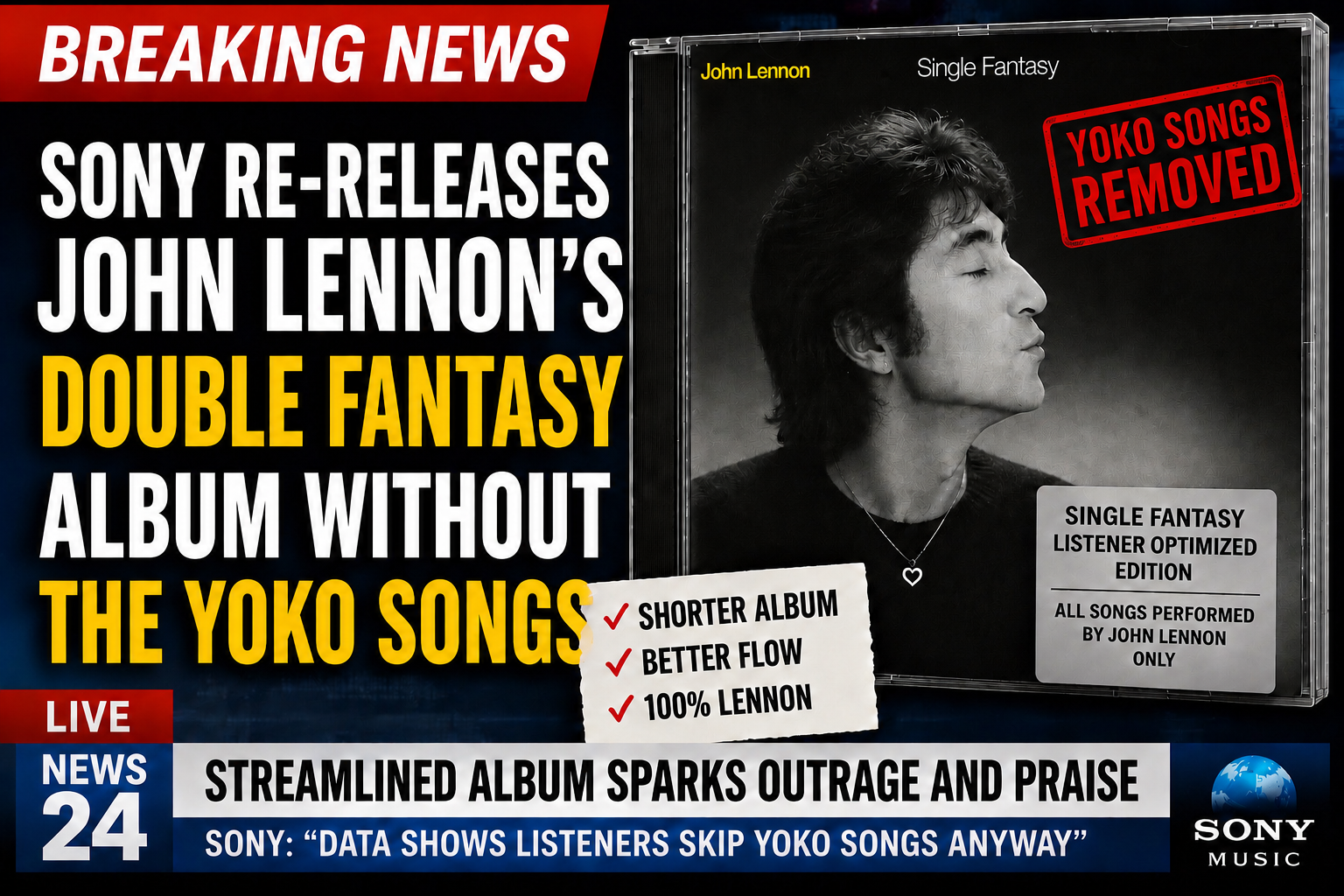
NEW YORK — Sony Music announced today the release of a newly remastered edition of John Lennon’s Double Fantasy that removes all songs performed by Yoko Ono and, according to company materials, “restores the album to its essential listening experience.”
The revised collection has been retitled Single Fantasy, a change Sony describes as “more accurately reflecting the current product configuration.”
“Consumers value transparency,” said a Sony executive during a press conference unveiling the project. “Calling it Double Fantasy after removing half the album felt potentially misleading.”
The new edition contains only Lennon performances, reducing the album from a musical conversation between two artists into what Sony’s marketing department calls “a focused, distraction-free Lennon journey.”
Company officials stressed that the decision was based entirely on listener behavior data.
“Our analytics revealed that many consumers had already created unofficial versions of the album containing only the Lennon tracks,” said Senior Vice President of Catalog Optimization Brent Halvorsen. “We simply decided to offer the experience they were already building themselves.”
The most controversial change, however, may be the album artwork.
Rather than commission a new cover, Sony elected to digitally remove Ono from the iconic photograph while leaving Lennon untouched. The revised image depicts Lennon leaning forward with his eyes closed, apparently attempting to kiss absolutely nothing.
According to Sony, multiple alternatives were considered.
“We experimented with replacing Yoko with a microphone, a guitar, and in one prototype a graph showing listener engagement metrics,” explained a designer involved with the project. “Ultimately we felt the empty space best communicated the artistic vision.”
The company describes the cover as “a powerful visual statement about focus.”
Critics have described it as “a powerful visual statement about Photoshop.”
Several music historians noted that Double Fantasy was intentionally structured as a dialogue between Lennon and Ono, with alternating tracks reflecting the couple’s shared experiences, perspectives, and artistic partnership.
Sony executives appeared unconvinced.
“Removing Yoko’s songs shouldn’t be interpreted as a criticism of Yoko,” said Halvorsen. “It’s simply an acknowledgment that if she hadn’t been romantically involved with John Lennon, there is virtually no chance she would have appeared on the album.”
Halvorsen added that the decision was based entirely on listener preferences and not on any assessment of artistic merit.
“The listeners made that assessment for us.”
Several reporters stared silently at the executive for nearly ten seconds before he asked whether there were any additional questions.
Reaction from fans has been sharply divided.
Some praised the release as “the version they’ve secretly been listening to for forty years.”
Others accused Sony of vandalizing a landmark album.
One Beatles fan described the revised cover as “the saddest image in rock history.”
Sony rejected that characterization.
“We see it as aspirational,” a company spokesperson replied.
The remastered release includes upgraded audio, expanded liner notes, and a bonus essay entitled Why Is John Kissing Nothing?, which attempts to explain the redesigned cover as a meditation on absence, loss, artistic focus, and evolving consumer preferences.
At press time, Sony confirmed it was evaluating additional catalog optimization opportunities, including a version of Let It Be containing only the songs people can hum and a newly streamlined collection of progressive rock albums in which every track ends just before the flute solo begins.