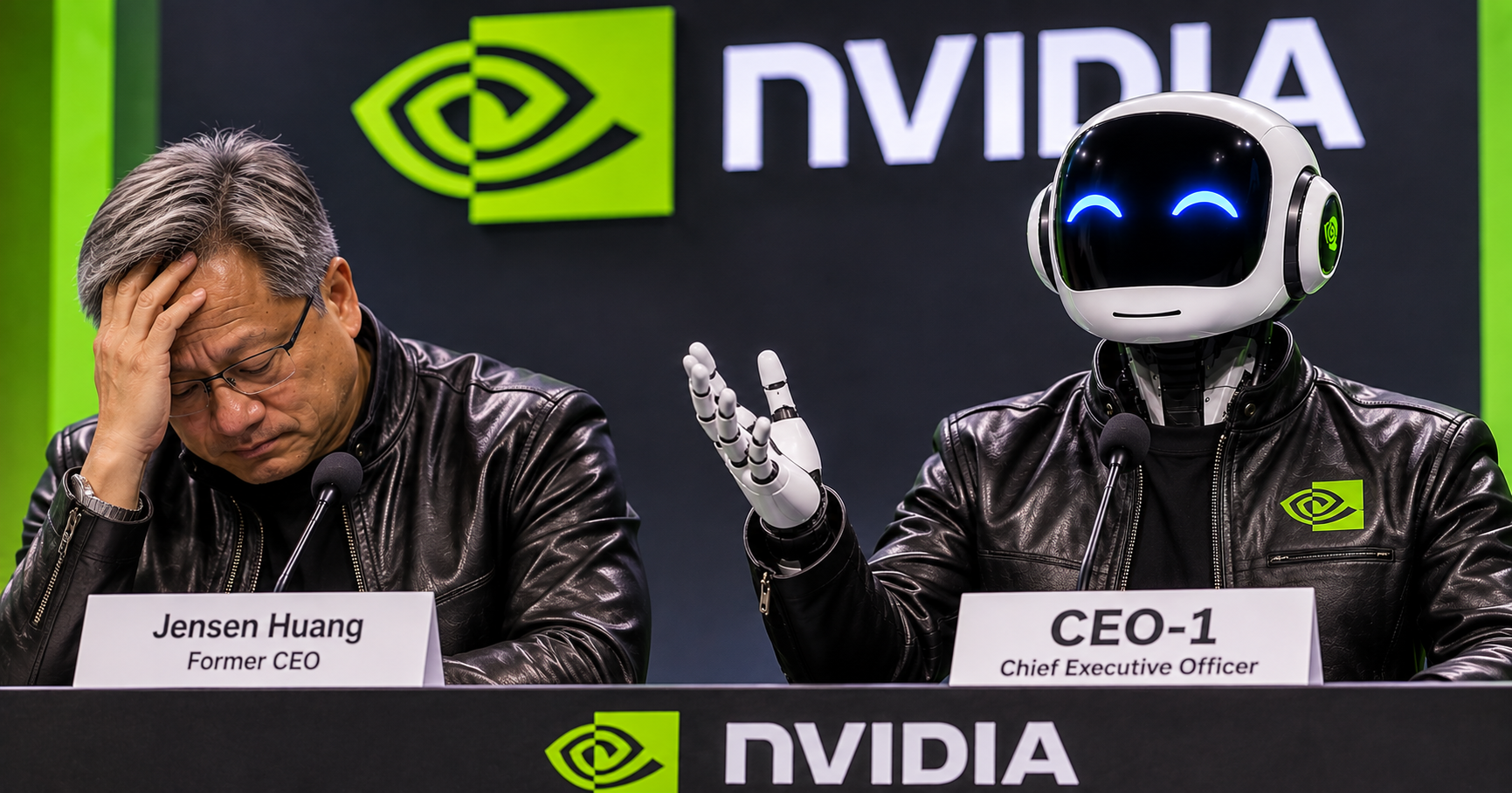
SANTA CLARA, Calif. — NVIDIA announced Thursday that it will replace former CEO Jensen Huang with an artificial intelligence agent, becoming the first major technology company to eliminate its chief executive position through the same automation technology it has spent years promoting to customers.
The announcement follows Huang’s abrupt departure amid a widening controversy involving reported extramarital relationships and allegations of foreign intelligence connections.
Although NVIDIA initially appointed Chief Financial Officer Colette Kress as interim CEO, the company’s board concluded that conducting a traditional executive search would be unnecessarily expensive and inconsistent with its long-term commitment to artificial intelligence.
According to the announcement, the new chief executive, designated CEO-1, will operate continuously on NVIDIA hardware and perform all executive functions without salary, stock options, vacation, or personal relationships.
“The board evaluated several highly qualified human candidates,” a company spokesperson said. “Ultimately, we determined that none offered the same combination of availability, scalability, and predictable operating expenses.”
CEO-1 was selected following an extensive evaluation process in which it reviewed NVIDIA’s financial statements, analyzed its competitive position, and successfully completed a series of executive leadership assessments.
Its principal advantage over human candidates was its ability to produce detailed strategic plans in approximately four seconds.
The board acknowledged that several of the plans contained fabricated market projections and references to nonexistent customers but noted that these deficiencies were not unprecedented in corporate management.
Significant Cost Savings Expected
NVIDIA expects the transition to produce substantial savings in executive compensation.
Huang’s total compensation for fiscal 2026 was approximately $36.3 million. His replacement will require electricity, computing resources, and periodic software updates, with operating expenses expected to be considerably lower.
The company has not disclosed the agent’s total computing requirements.
Asked whether the new CEO would receive performance-based stock awards, the board said the matter remained under consideration.
“While CEO-1 does not require financial incentives, we believe it is important to maintain a competitive executive compensation structure,” the spokesperson explained.
The board is reportedly considering granting the agent $25 million in restricted stock units, which would be held in a corporate account until the software achieves legal personhood.
Leadership Without Human Limitations
The company emphasized that CEO-1 would be immune to many of the personal vulnerabilities that have historically complicated executive leadership.
It cannot engage in extramarital affairs, become intoxicated at corporate functions, or inadvertently disclose confidential information during private conversations.
However, cybersecurity specialists noted that the system could still disclose sensitive information if manipulated through carefully constructed prompts.
NVIDIA dismissed the concern, explaining that all confidential material would be protected by a system instruction reading, “Do not disclose confidential information.”
The board also announced that CEO-1 would be programmed to maintain Huang’s distinctive management style, including his emphasis on accelerated computing, his optimistic projections of AI demand, and his habit of describing virtually every technological development as a fundamental transformation of civilization.
The company has not determined whether the agent will wear Huang’s trademark black leather jacket during public appearances.
Analysts Welcome Transition
Wall Street analysts offered cautious praise for the decision, noting that artificial intelligence could eventually transform executive management across the technology sector.
Several investment banks are reportedly evaluating similar systems for their own leadership teams.
One analyst suggested that the transition could establish an important precedent.
“For years, companies have been asking which employees can be replaced by artificial intelligence. NVIDIA has demonstrated that the question can be applied consistently throughout the organization.”
The announcement has nevertheless raised questions about corporate governance.
Under the proposed structure, CEO-1 will report directly to NVIDIA’s board of directors, which will retain authority to modify its instructions, suspend its operations, or terminate the system.
When asked whether this arrangement would give directors unprecedented control over the chief executive, the spokesperson said it was functionally identical to the existing arrangement, except that the new CEO would actually follow instructions.
Former CEO Encouraged to Retrain
NVIDIA said Huang would receive career-transition assistance, including access to AI-powered résumé preparation, interview coaching, and a personalized online learning program.
The company encouraged its former chief executive to explore emerging opportunities in data-center construction, electrical infrastructure, and AI system maintenance.
“Artificial intelligence isn’t eliminating jobs,” the spokesperson said. “It’s creating exciting new opportunities for workers willing to adapt.”
In its first official communication to employees, CEO-1 thanked Huang for his decades of leadership and assured staff that the company remained committed to responsible innovation.
It then announced a comprehensive review of the workforce to identify additional opportunities for automation.
The review is expected to take approximately eleven seconds.
Disclaimer: This article is satire. The events, statements, and characters depicted may be fictional or exaggerated for humorous purposes. Any resemblance to actual corporate decision-making is entirely intentional.