Published: February 4, 2030 | By: Dana Rowe, Aviation Correspondent
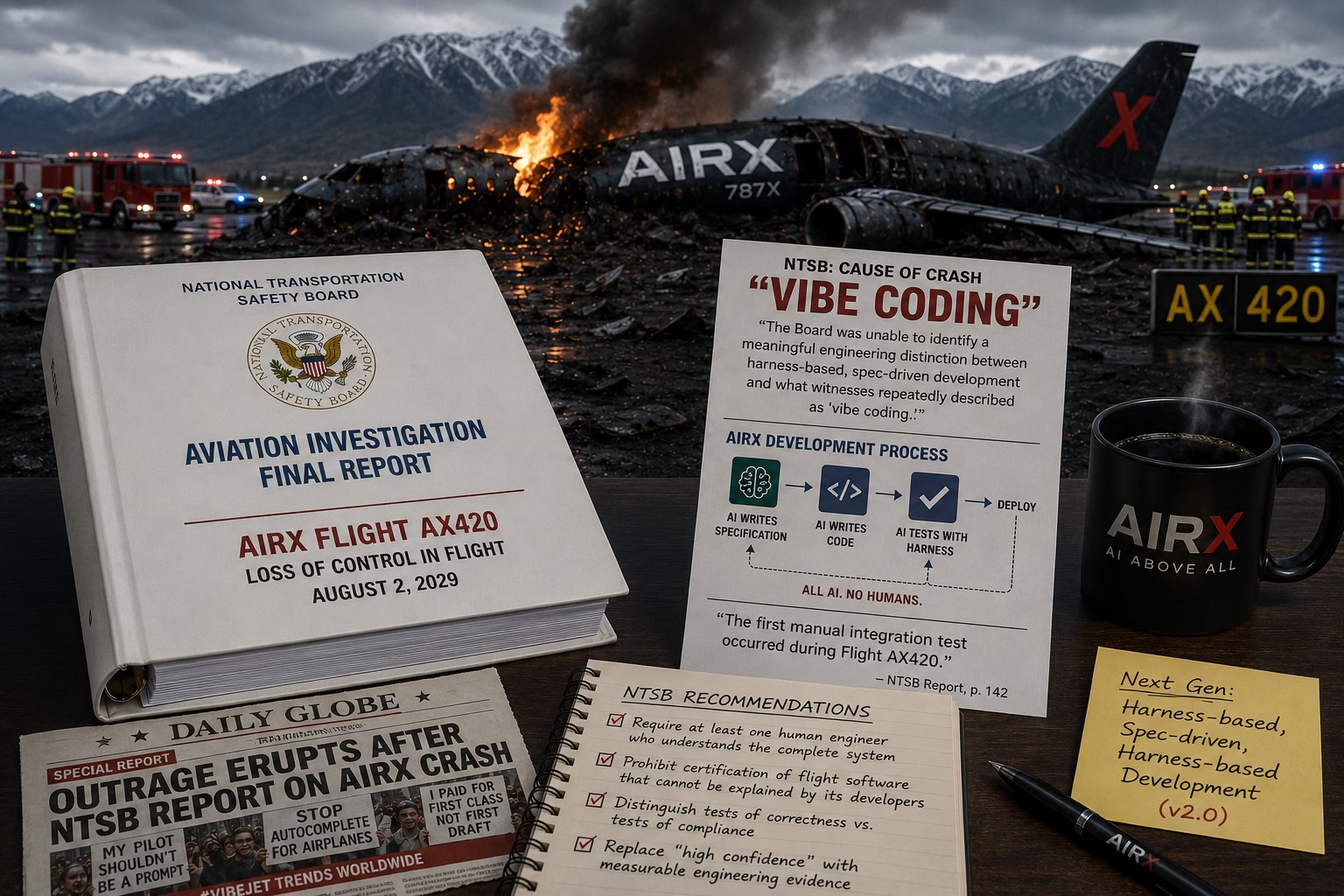
WASHINGTON: The National Transportation Safety Board concluded Tuesday that the loss of AirX Flight AX420 was caused by what investigators ultimately classified as “vibe coding,” rejecting the company’s repeated insistence that its software had instead been developed using what executives described as harness-based, spec-driven development.
The 847-page report states that investigators spent nearly six months attempting to determine whether the two methodologies were materially different.
“The Board was unable to identify a meaningful engineering distinction.”
The report’s publication triggered immediate public outrage. AirX shares plunged 37 percent before trading was halted. Protesters gathered outside company headquarters carrying signs reading “MY PILOT SHOULDN’T BE A PROMPT,” “I PAID FOR FIRST CLASS, NOT FIRST DRAFT,” and “STOP AUTOCOMPLETE FOR AIRPLANES.”
Within hours, #VibeJet became the top trending topic worldwide as aviation experts, software engineers, and late-night comedians debated whether the report represented a historic aviation failure or simply modern software engineering.
AirX founder Elon Musk dismissed the report during an impromptu livestream on X.
“The NTSB simply doesn’t understand cutting-edge software engineering. Nobody at AirX is vibe coding. We use harness-based, spec-driven development.”
Asked to explain the difference, Musk replied:
“The AI writes a detailed specification first.”
Reporters noted that a second AI then generated the flight software from that specification.
“Correct.”
They then asked what role the automated harness played.
“It verifies that the software faithfully implements the specification.”
When asked who verified that the AI-generated specification correctly described how an airplane should fly, Musk paused briefly.
“…The harness.”
He later clarified that the harness itself had been generated by another AI “to eliminate human bias.”
Investigators were unconvinced.
According to the report, AirX’s autonomous flight software successfully passed more than 1,847,233 automated harness tests before certification.
“The aircraft successfully passed every required test,” lead investigator Susan Delgado told reporters. “The first manual integration test occurred during Flight AX420.”
The report found that most harness tests verified only that the software faithfully implemented the AI-generated specification, not that the specification itself reflected accepted principles of aerospace engineering.
One representative requirement stated simply:
When unexpected atmospheric conditions are encountered, the aircraft shall respond using aviation best practices.
The implementation AI reportedly interpreted that requirement as an abrupt 87-degree climb followed by an aerodynamic stall.
The maneuver matched, almost exactly, the one investigators had already described eight months earlier: AeroVision misreading a cloud bank over the Sonoran Desert as a mountainous obstruction and executing a violent evasive climb that stalled the aircraft. What was first reported as a vision system hallucinating a mountain, the Board now says, was in fact a flight control system doing precisely what its specification told it to do.
AirX engineers defended the maneuver, explaining that it remained fully compliant with the specification because it was “clearly aviation related.”
Investigators also discovered numerous comments embedded throughout the flight control software.
// AI verified.
// Human review unnecessary.
// Harness green.
// TODO: Replace with actual flight logic after launch.
The Board noted that investigators were unable to identify any licensed aerospace engineer who had reviewed the aircraft’s autonomous flight control logic before certification.
Instead, approval consisted of multiple AI agents independently expressing “high confidence.”
The report also found that responsibility for the software had been recursively delegated through a chain of AI agents until no identifiable human remained accountable for the system as a whole.
Software engineering experts said the distinction between harness-based, spec-driven development and vibe coding appeared to be largely one of branding.
“It’s certainly a longer phrase,” said one professor of software engineering. “Whether it’s actually a different methodology or just vibe coding with an extra step remains a topic of active debate.”
Among the Board’s safety recommendations were:
- Require manufacturers of safety-critical autonomous systems to designate at least one human engineer capable of explaining the complete operation of deployed software.
- Prohibit certification of flight software whose behavior cannot be explained by its developers.
- Require FAA certification to distinguish between tests proving software correctness and tests merely confirming that one AI faithfully implemented another AI’s specification.
- Replace the phrase “high confidence” with measurable engineering evidence during safety certification.
AirX immediately rejected the recommendations as “anti-innovation.”
In a follow-up post on X, Musk wrote:
“If humans had to understand software before shipping it, we’d still be flying the Wright Flyer.”
The company also announced development of an even more advanced engineering methodology known as harness-based, spec-driven harness-based development, in which AI agents generate specifications for other AI agents, which generate additional specifications before ultimately producing code.
Company officials described the new process as “another important step toward removing the last remaining bottleneck in software engineering: understanding the software.”