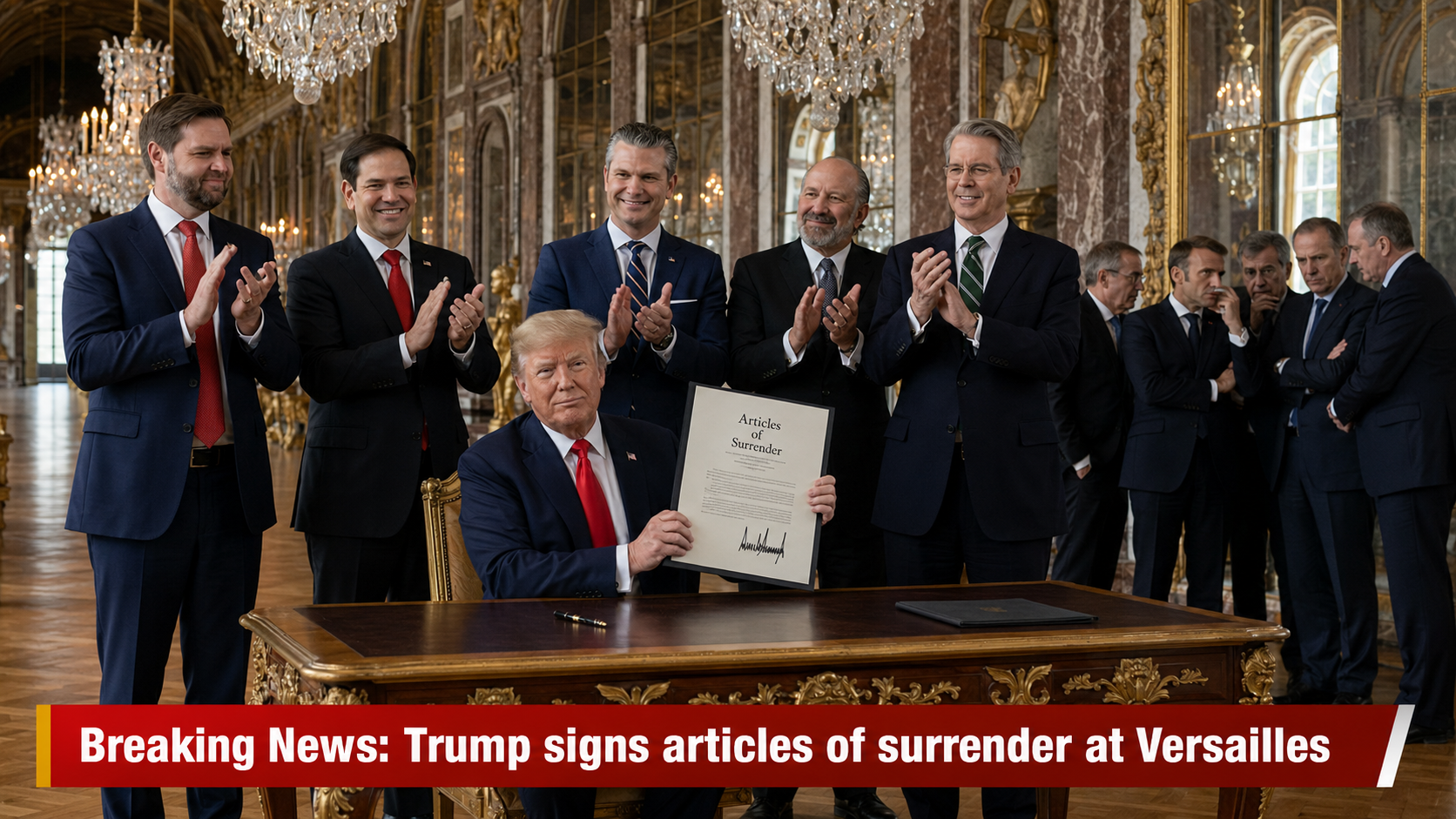
VERSAILLES, FRANCE — President Donald Trump formally signed Articles of Surrender Wednesday at the Palace of Versailles, bringing an end to months of hostilities between the United States and Iran.
The signing ceremony took place during a state dinner attended by world leaders, diplomats, and administration officials, who praised the agreement as a historic achievement and one of the most successful capitulations ever negotiated by an American president.
“This is a beautiful deal,” Trump told reporters. “A lot of people didn’t think we could get such a beautiful deal. We signed it in Versailles. Everybody’s talking about it.”
Under the terms of the agreement, the United States will begin lifting sanctions, release frozen Iranian assets, and enter an additional sixty-day negotiating period covering many of the same issues that were under discussion prior to the conflict.
White House officials rejected suggestions that the surrender represented any sort of setback.
“A military victory ends when your enemy accepts your demands,” explained one senior administration official. “A diplomatic victory ends when you accept theirs. The distinction is very important.”
Officials further stressed that the surrender was entirely voluntary and should not be confused with the kind of surrender historically associated with military failure.
“This is what we call a strategic capitulation,” said another official. “The President achieved every objective that remained achievable after abandoning the original objectives.”
The Palace of Versailles was selected for the ceremony due to its elegant architecture, excellent catering facilities, and complete lack of historical symbolism.
“The President specifically requested a venue that would avoid sending the wrong message,” said one aide.
Witnesses reported a brief moment of silence during the ceremony when Trump again reminded reporters that the agreement had been signed at Versailles.
According to sources familiar with the matter, several French diplomats immediately excused themselves to compose their thoughts.
The White House later released a fact sheet explaining that modern surrender doctrine differs significantly from traditional surrender doctrine and may, under certain circumstances, be operationally indistinguishable from victory.
Administration officials also objected to media characterizations of the agreement as a peace settlement.
“This is not a peace settlement,” said a State Department spokesperson. “This is a victory-oriented surrender framework designed to facilitate the orderly transfer of negotiating leverage.”
Treasury officials confirmed that several frozen Iranian assets would be released as part of the agreement, describing the transfers as “reverse reparations” and urging reporters not to focus on terminology.
The administration further emphasized that the agreement represented a major triumph for American foreign policy, noting that it successfully returned all parties to a position from which negotiations could continue.
“That’s the mark of effective leadership,” said one official. “Many presidents negotiate first and avoid the war entirely. President Trump had the courage to negotiate after.”
The White House concluded the evening by announcing plans for a commemorative medal recognizing individuals who contributed to the surrender effort.
At press time, administration officials were reportedly preparing educational materials explaining that surrender is only surrender if the other side chooses to describe it that way and all required paperwork has been properly filed.