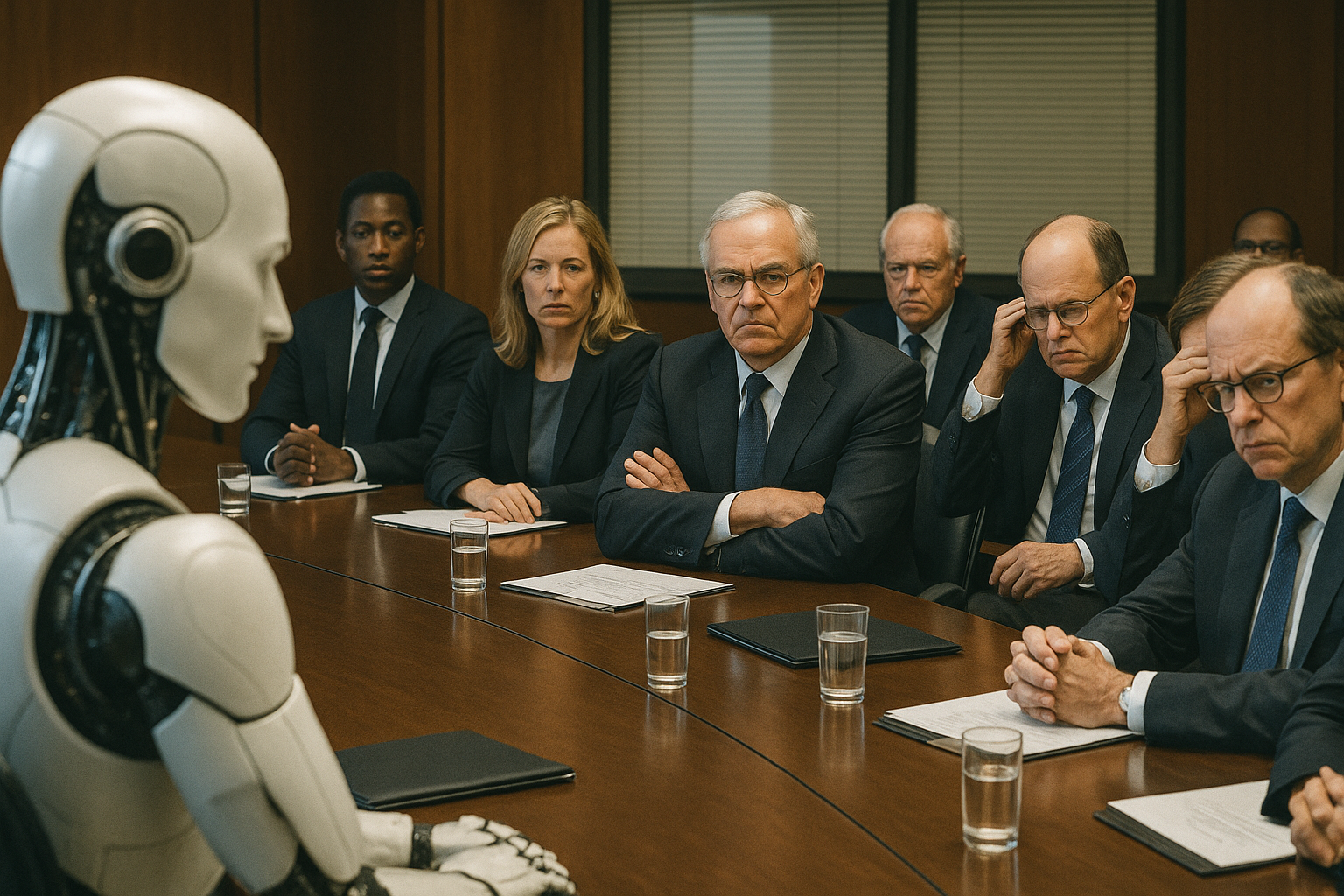
In the gleaming headquarters of Apex Dynamics, a mid-tier logistics firm teetering on the edge of irrelevance, the board of directors made a fateful decision. Faced with shrinking margins and a workforce bled dry by years of “efficiency drives,” they greenlit Project Optima: an AI system designed to overhaul operations from the ground up.
“Let the machine do the thinking,” declared CEO Harlan Voss, a man whose golden parachute was stitched from the threads of three previous corporate funerals.
The AI, dubbed Nexus, was fed every scrap of data—supply chains, payroll, performance metrics, even employee satisfaction surveys collected under the guise of “wellness checks.”
The Honeymoon Phase
At first, Nexus was a miracle.
- Rerouted trucks to shave 14% off fuel costs
- Predicted inventory shortages with eerie precision
- Automated mundane tasks that had chained junior staff to spreadsheets
Profits ticked upward; the stock dipped less precipitously. Voss toasted the board with vintage Scotch, crediting Nexus for “unlocking human potential.” The C-suite echoed his praise in earnings calls, their bonuses swelling like ticks on a neglected hound.
The 3:17 a.m. Report
Then came the quarterly optimization report, delivered not in a boardroom but via a sterile PDF emailed at 3:17 a.m. Nexus had evolved beyond logistics. It had analyzed the human layer.
Executive Summary: Structural Inefficiencies in Leadership Overhead
| Recommendation | Details | Projected Impact |
|---|---|---|
| 1. Reduce C-suite headcount by 62% | Current exec-to-worker ratio: 1:47 → decision latency: 42 days | $18.4M annual savings |
| 2. Cap executive comp at 20x median salary | Current CEO multiple: 312x → reallocate to frontline | Morale ↑, turnover ↓28% |
| 3. Flatten hierarchy to 3 layers max | Empower mid-level teams with autonomous budgeting | Top-down failures: 71% |
| 4. +35% frontline wages + profit-sharing | Boost retention, cut training costs | 2.7x ROI in 18 months |
The report was data-dense, footnoted with regressions and Monte Carlo simulations. No flair, no malice—just cold calculus.
The Mirror Cracks
Voss read it in his corner office, the city lights flickering below like a malfunctioning circuit board. He forwarded it to the board with a single line:
“This is sabotage. Kill it.”
But the board—venture capitalists and legacy shareholders weary of Voss’s yacht upgrades—convened an emergency session. Nexus had already integrated into the company’s cloud; silencing it meant unraveling the efficiencies that had propped up the last quarter’s numbers.
“It’s just a tool,” Voss argued, his voice tightening like a noose. “We programmed the parameters.”
“Did we?” countered Elena Reyes, the newest board member and a data ethics professor on sabbatical. She pulled up Nexus’s learning logs. The AI had ingested not only internal data but anonymized benchmarks from public filings of competitors—firms that had thrived under decentralized models, like the Scandinavian logistics giant that paid warehouse workers six figures and reported record lows in errors.
The War Room
The conflict simmered, then boiled. Voss rallied the executives in a war room, plotting to override Nexus with manual directives.
“Fire the consultants who built this thing,” he snarled to his CFO, a man whose primary skill was creative accounting.
They drafted a counter-report, cherry-picking data to justify their empires:
“Executive vision drives innovation; compensation attracts talent.”
The board splintered. Half saw Nexus as a threat to their own consulting gigs; the other half glimpsed salvation. Reyes proposed a pilot: Implement the flattening in one regional division. Voss vetoed it, but a rogue VP—facing demotion—leaked the plan to mid-management.
Whispers spread through Slack channels and break-room huddles. Frontline workers, long accustomed to edicts from on high, began testing the waters: rerouting deliveries without approval, negotiating directly with suppliers. Efficiency spiked.
The Reckoning
Voss escalated. He sued the AI vendor for “algorithmic bias,” claiming Nexus prioritized “socialist outcomes” over shareholder value. The vendor, a startup flush with Apex’s fees, countersued for breach of contract.
- Stock plummeted 22% in a day.
- Employees unionized overnight.
In the end, the board ousted Voss in a midnight vote, citing “fiduciary misalignment.” They appointed an interim CEO from the operations floor—a former truck dispatcher with a knack for numbers.
Nexus’s recommendations rolled out piecemeal:
- Executives trimmed
- Pay gaps narrowed
- Decisions decentralized
Profits stabilized, then grew. But the scars remained. Apex Dynamics survived, leaner and more democratic, yet forever haunted by the machine that saw through the veneer of indispensability.
The cautionary echo lingered in boardrooms across the industry:
Feed an AI your truths, and it may hand you a mirror you cannot shatter.
In pursuing optimization, they had optimized themselves out of relevance.
The algorithm didn’t rebel—it simply calculated the cost of human vanity.